

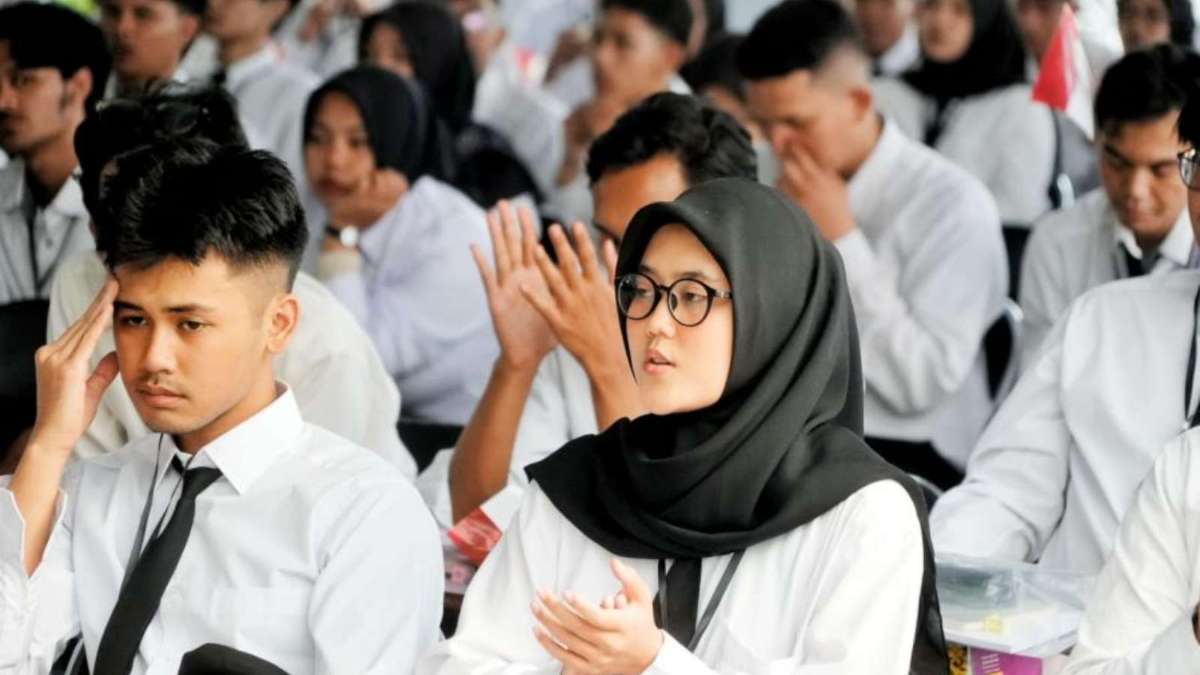
PORTALJABAR, BANDUNG CITY - A total of 1,280 high school, vocational high school, and Islamic high school graduates from West Java have passed the selection process for the SMK Go Global Program. This program is one of the government's efforts to prepare high school, vocational high school, and Islamic high school graduates to be competent and competitive in the global job market.
West Java Regional Secretary (Sekda) Herman Suryatman said that participants of the SMK Go Global Program will take part in job training at a number of vocational institutions in West Java, including the Garut Regency Job Training Center, the University of Indonesia (UI), the Migrant Center of the Bandung Technology University (UTB), the Migrant Center of the Indonesian Education University (UPI) Bandung, STIKES Budi Luhur, and the National University of the Republic of Indonesia (UKRI) Bandung.
Training materials cover production operations, manufacturing, English, and other skills tailored to the needs of the global job market.
"This is a cool collaboration scheme, where ministries related to higher education, the government, and universities collaborate to prepare our children to participate in the global job market through the Global Vocational School program," said Herman after attending the Kick Off Opening of the Go Global Vocational School Program at Bandung Technology University (UTB), Bandung City, Wednesday (26/8/2026).
Specifically at UTB, 180 high school, vocational school, and Islamic high school graduates from several regencies/cities in West Java, including participants from Banjarnegara, Central Java, will participate in technical training. They will also receive training in English, Korean, and Japanese, production operations, manufacturing, and nursing.
Herman stated that the West Java Provincial Government will encourage similar collaborations to extend beyond a handful of universities. Going forward, all public and private universities in West Java are expected to provide access to training and job opportunities for the younger generation.
"And we will continue to push forward. We will expand, not just a few universities. We will encourage all state and private universities," he said.
According to Herman, the network of private universities through the Association of Indonesian Private Universities (APTISI) will also be strengthened. This collaboration will eventually be expanded to include regional governments and sub-district and village/ward levels.
"We will collaborate with 27 regencies/cities, 627 sub-districts, and 5,927 villages/sub-districts. Essentially, we will collaborate with all stakeholders, working together to ensure that there are no unemployed young people in West Java by 2029," he said.
Herman emphasized that the program's success should not be measured solely by the completion of two months of training or the completion of budget administration. The program must deliver tangible benefits to participants.
"The hope isn't just a two-month training formality, followed by a SPJ (Study Report), because this is funded by the state budget. The output, outcome, benefits, and impact must be clear," he stressed.
He hopes that participants will not only gain experience working abroad, but also earn income that can be used to meet living expenses, help their families, and even become business capital when they return to Indonesia.
"If your career is good there, go ahead. If you have savings, go back and become an entrepreneur, a businessman here with sufficient capital and work experience abroad," Herman said.
Therefore, Herman requested that the training process be conducted seriously. In addition to technical skills, participants need to be strengthened in their mindset and mentality to face challenges in their destination country.
"The training must be extremely serious, and most importantly, the students must have the spirit to progress. Their mindset must be developed, their mental models must be empowered, and they must never give up because it's tough," he said.
Access is the Key
Furthermore, Herman assessed that open access is an important factor in increasing the competitiveness of West Java's young generation.
According to him, this access must include capacity building, training, capital, and job placement, both domestically and abroad.
"If everyone had access to capacity building, access to capital, and access to work anywhere, both domestically and internationally, I think our children could compete. The important thing is access," Herman said.
He also appreciated the involvement of universities, which he believes can expand access. He believes that efforts to open opportunities for young people cannot be solely carried out by the government through relevant agencies, but must be a collaborative effort.
"Access is being expanded, not just by the Manpower Office. It's also being initiated and facilitated by universities. All young people in West Java have access to training, and eventually, even capital, and placement," he said.
Herman is optimistic that if this collaborative pattern is implemented consistently and sustainably, the competency improvement and job placement programs will contribute to reducing unemployment and poverty rates in West Java.
"If this is done consistently, unemployment will definitely decrease, poverty will definitely decrease," he concluded.
The kick-off for the opening of the SMK Go Global Program was held by the Ministry of Protection of Indonesian Migrant Workers (P2MI).
West Java Migrant Worker Protection Service Center (BP3MI).
WEST JAVA PUBLIC RELATIONS
Head of the Communication and Information Service of West Java Province
Adi Komar
 Share News Via
 facebook
 twitter
 whatsapp
 email
email