

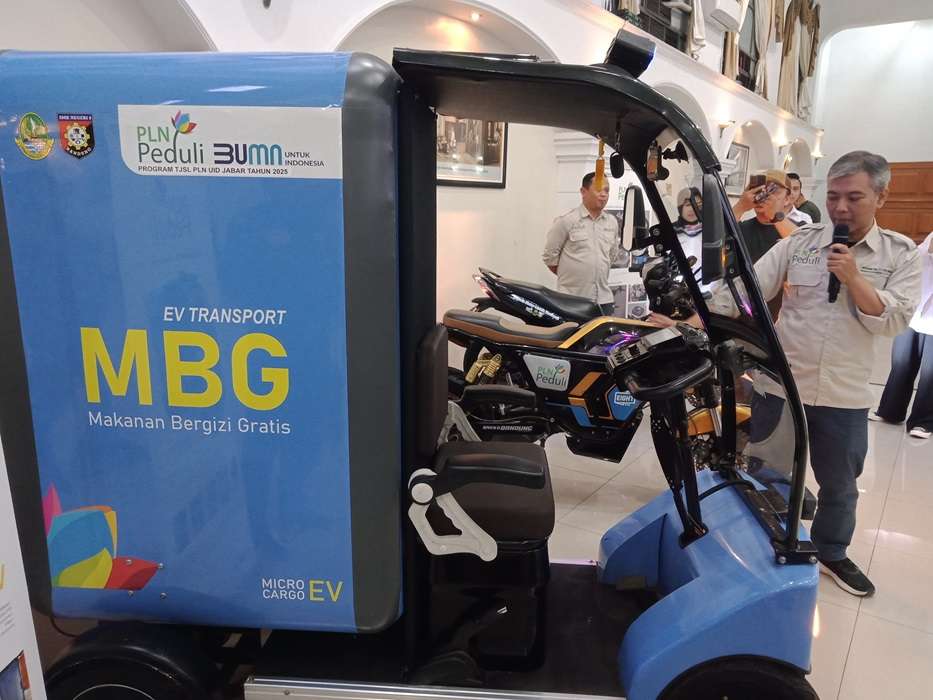
PORTALJABAR, BANDUNG CITY - SMKN 8 Bandung has implemented an innovation for distributing free nutritious meals (MBG) within the school environment. The electric vehicle (EV) developed by SMKN 8 Bandung students is the EV Micro Cargo.
Head of the Motorcycle Engineering Sub-Expertise Concentration at SMKN 8 Bandung, Edwin Hadiyanto, admitted that the prototype was used to take the MBG menu from the school's SPPG to each class.
"This EV Micro Cargo was built for MBG distribution within schools at a cost of Rp60 million. It can transport 100 portions of MBG," said Edwin on Monday (April 13, 2026).
Edwin added that the electric vehicle conversion project has been underway since 2022 and has successfully assembled a prototype electric motorcycle converted from a fossil-fueled engine.
"The electric vehicle being assembled is a sports motorcycle. The prototype conversion electric motorcycle requires a budget of IDR 17 million. Meanwhile, the prototype sports motorcycle costs IDR 40-50 million," he said.
General Manager of PLN West Java Main Distribution Unit (UID) Sugeng Widodo supports the steps taken at SMKN 8 Bandung through the social and environmental responsibility (TJSL) program to strengthen the competency of practice-based electric motor conversion.
"This program is part of PLN's role in supporting the energy transition by strengthening human resources. SMKN 8 Bandung is not only a place of learning but also a real-life laboratory for electric vehicle development," he said.
PLN UID Jabar is providing comprehensive support worth Rp315.6 million. The program focuses not only on providing facilities but also includes curriculum alignment, improving teacher and student competencies, and strengthening practice-based learning through the Teaching Factory (TEFA).
The learning process becomes more applicable with regular time allocation every week, supported by new facilities in the form of electric vehicles or Electric Vehicle/EV Class and TEFA 8 Motor practical workshop.
A total of 16 teachers and 165 students received direct training from industry practitioners, complemented by pre- and post-test evaluation methods and certification. The program's impact was also expanded through the involvement of networked vocational schools, where eight teachers and 16 students also received similar competency enhancement.
In terms of facilities, PLN also provided support in the form of a converted electric motorcycle prototype and the development of the Micro Cargo EV innovation. These vehicles are used to support the distribution of the Free Nutritious Meals (MBG) program within schools and serve as a hands-on learning platform for students.
The transformation in learning has begun to be significant. A total of 181 students now understand the comprehensive electric vehicle conversion process, while 24 teachers have acquired the competency to teach the material independently. The available facilities have also met the requirements for a Type B certified conversion workshop, even opening up opportunities for development into a Regional Public Service Agency (BLUD). (Parno)
 Share News Via
 facebook
 twitter
 whatsapp
 email
email