

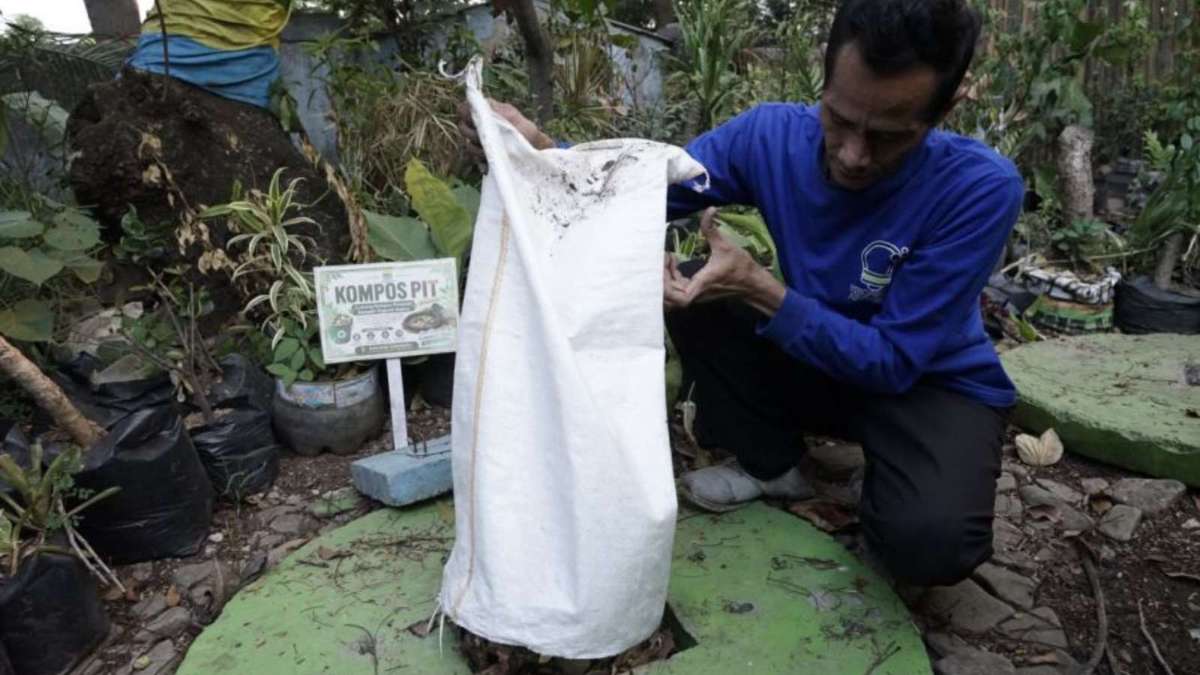
PORTALJABAR, BANDUNG CITY - Sukamiskin Village, Arcamanik District, Bandung City, continues to strengthen community-based waste management by building a processing ecosystem from the household to the village level.
Various methods have been implemented, ranging from sorting waste at home, processing organic waste using maggots and composters, to processing non-organic waste into alternative fuels in the form of briquettes.
Sukamiskin Village Head, Sofian Ismail, said that waste management in his area is carried out in stages by involving the community, RT, RW, and various elements of community institutions.
One of the ongoing processes is cultivating maggots to decompose organic waste. Currently, this process has a capacity of around 400 to 500 kilograms of waste per day, although the target is to reach one ton per day in the future.
"The maggot production capacity is around 400 to 500 kilograms per day. The target is one ton, but because maggots are living creatures, it's naturally affected by temperature and other factors," Sofian told Bandung City Public Relations.
In addition to processing at the sub-district level, Sukamiskin also encourages changes in community behavior through a waste sorting program at the source.
According to Sofian, around 500 households have received outreach and education on sorting waste into organic, non-organic, and residual. Of these, around half, or approximately 250 households, have begun sorting and processing their own waste.
"So, we've been conducting outreach and education on sorting organic, non-organic, and residual waste. Around 500 households have received outreach, and around 250 households have started sorting and processing," he said.
These efforts are reinforced by the provision of processing facilities in each neighborhood unit (RW). Of the 17 RWs, each has at least two composting-based processing facilities, while some have up to five.
Sofian said the facility allows people to process organic waste directly without having to take it to a temporary disposal site (TPS).
"Our target is 100 percent sorting at source. At least 50 percent of households will sort and process their own waste at home," he said.
In addition, Sukamiskin Village is developing another waste processing facility through waste briquetting. This facility currently has six machines used to process non-organic waste into briquettes.
The process begins by loading non-organic waste into a processing container. The waste is then stacked in stages, approximately 20 centimeters thick, and bioactivator is added. This process is repeated until the pile reaches approximately 1.2 meters.
After drying for at least seven days, the waste is then ground using a machine. The stages include coarse grinding, fine grinding, and mixing with a starch adhesive before being molded into briquettes.
"Once dry, the waste is ground. There are coarse grinding machines and fine grinding machines, then it's mixed with starch so that when molded, it holds together and doesn't break easily," explained Sofian.
If all facilities are running optimally, the non-organic waste processing capacity is projected to reach six tons per day.
Sukamiskin Subdistrict is also prepared as a waste management laboratory, a place where communities, RT, RW, non-governmental organizations, and other areas that want to conduct pilot studies can directly observe the waste management process.
"We're targeting this sub-district to become a waste management laboratory. We've prepared a space on the second floor with a capacity of around 20 people to receive guests and hold presentations," he said.
Briquette processing development is also planned to be expanded to the neighborhood unit (RW) level. RW 13, Sofian said, has expressed its readiness to become a production site. Approximately 200 square meters of land has been prepared, with space allocated for production machinery, drying, and storage.
The plan is that the briquettes produced will be collected and transported to be used by various industrial sectors, such as cement factories, roof tile factories in Majalengka, and the textile industry.
"RW 13 is ready. The location is around 200 square meters, part of which is for the machine and the other part is for drying and storage," he said.
In addition to processing at the sub-district level, Sukamiskin is also developing collaboration with Bandung Islamic University (Unisba) and the West Java Provincial Government through cold plasma technology to process non-organic waste.
The facility was previously capable of processing around 1.5 tons of non-organic waste per day during its initial operation. However, the machine is currently experiencing problems and is awaiting replacement components, which must be imported.
Sofian hopes that the facility will be operational again soon, increasing Sukamiskin's waste processing capacity.
If all processing facilities are operational, Sukamiskin could even potentially receive waste from other areas because its processing capacity is projected to exceed the waste generated by the local community.
Currently, waste generation in Sukamiskin is estimated at 4 to 6 tons per day. Of this amount, approximately 30 percent still needs to be transported to the landfill (TPS), while the remainder is gradually directed to be processed through various available facilities.
Waste management at source is also strengthened through the Waste Sorting and Processing Officer (Gaslah) program. In Sukamiskin, there are approximately 17 officers tasked with assisting with waste management in each neighborhood unit (RW).
These officers not only collect waste from residents' homes, but also encourage the sorting process before the waste is taken to the processing point.
"There are currently around 17 Gaslah officers, one per neighborhood unit (RW). They sort organic materials. The DLH target is around 25 kilograms per day, and that has been exceeded. Some are producing 60 kilograms, and some are even producing more than 100 kilograms," said Sofian.
At the neighborhood unit (RT) level, waste collection from residents' homes continues. The collected waste is then taken to the Gaslah collection point for sorting. Organic waste is directed to processing facilities such as composters and maggot farms, while non-organic waste proceeds to the next stage of processing.
Waste Becomes Social Benefit
Interestingly, waste management in Sukamiskin doesn't stop at reducing waste volume. The organic waste processed through maggots also produces kasgot, or used maggot media, which can be used as fertilizer for plants.
The proceeds are used to support food gardens within the sub-district. Various crops, including spinach, bok choy, kale, and purple sweet potatoes, are cultivated and harvested regularly.
The ecosystem is also integrated with a laying hen farm. Currently, the hens produce around 60 to 90 eggs per day.
These eggs are then used to support the fulfillment of community nutrition, especially pregnant women, toddlers, and residents who are underweight.
"We produce around 60 to 90 eggs a day. These are distributed to pregnant women and toddlers, especially those who are thin or underweight," said Sofian.
Thus, waste management in Sukamiskin has developed into an ecosystem that connects waste sorting, organic processing, maggot cultivation, compost production, agriculture, and the fulfillment of food and nutrition for the community who are members of the Karasa Program Circle (Bandung Utama Circle).
Sofian explained that the available land area is one of Sukamiskin Village's strengths in developing this ecosystem. Of the approximately 3,000 square meters of available land, only about 800 square meters have been used for buildings, leaving ample room for development.
"This ecosystem is a source of pride for Sukamiskin. Thankfully, we have ample land to develop," he said.
Sofian hopes that all processing facilities will operate optimally in the future. With support from the provincial government and various parties, the new processing facilities are expected to be operational by the end of this year or at the latest in early 2027.
"Once the waste purification process is underway and the cold plasma system is operational again, we can even accept waste from other sub-districts. In terms of calculations, our processing capacity could be greater than the waste generated by Sukamiskin residents," he explained.
(Bandung City Communications and Information Service/rka)
 Share News Via
 facebook
 twitter
 whatsapp
 email
email