

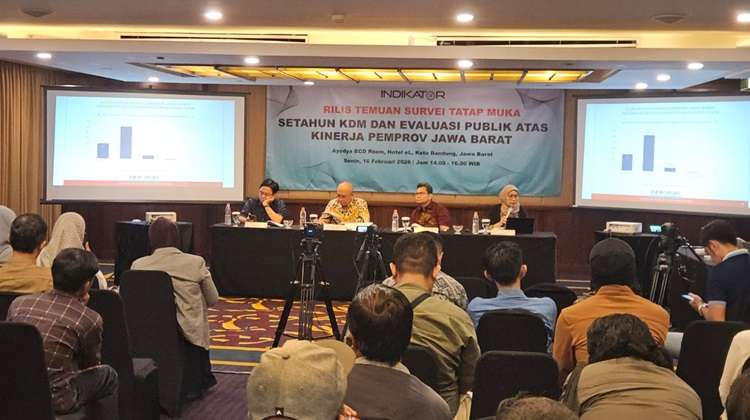
PORTALJABAR, BANDUNG CITY - West Java residents' satisfaction with Dedi Mulyadi's performance as Governor over the past year has been very high, according to a survey conducted by the Indikator survey institute between January 30, 2026, and February 8, 2026.
Indicator founder and researcher Prof. Burhanudin Muhtadi stated that satisfaction with the performance of KDM, Dedi Mulyadi's nickname, as Governor of West Java reached 95.5 percent, a very high level. Compared to findings from May of last year, public satisfaction levels remained relatively stable and even tended to increase.
Meanwhile, the number of samples in the survey reached 800 respondents spread across villages in 27 districts and cities in West Java.
"This indicates that the initiatives taken at the start of Dedi Mulyadi's tenure after his inauguration not only received high enthusiasm from the people of West Java, but the evaluation of their implementation also received high appreciation throughout his nearly one-year term," he said at the El Hotel Bandung on Monday (February 16, 2026).
Only a small group of citizens are satisfied with less than 90 percent, and even then it is not less than 80 percent in each demographic segment and region of West Java.
The people sampled in this survey were satisfied with KDM's work programs, including the elimination of fines and vehicle tax arrears in West Java. This program provided incentives for approximately one-third of West Java residents and added 1.4 million new taxpayers.
This is inseparable from extensive public outreach activities, including outreach regarding the allocation of collected vehicle tax funds as a form of transparency to citizens. As a result, public trust and support are very high.
Likewise, other work programs were deemed satisfactory by the public. For example, the ban on school study tours, curfews for school students, and sending problem students to military barracks.
Programs in the infrastructure sector are also satisfactory for the people of West Java, such as the construction and repair of hundreds of kilometers of roads, the provision of public street lighting, and the installation of free electricity.
Including environmental programs, such as river normalization and closing illegal mines, are also considered satisfactory by the community.
Budget reallocation
In the context of the central government's budget efficiency policy which has a very significant impact on the fiscal capacity of regional governments, Dedi Mulyadi is considered successful in carrying out budget reallocation and efficiency by shifting less important expenditures into expenditures that are beneficial for fulfilling the basic needs of the community.
West Java Province was also named the best province in Indonesia in implementing the 2025 Minimum Service Standards.
"According to Statistics Indonesia (BPS), despite the severe pressures stemming from the central government's budget efficiency policies, West Java demonstrated better economic performance than the national average in 2025. Economic growth reached 5.8%, above the national average," he explained.
Another conclusion from the survey, Burhanudin added, is that West Java residents' perceptions of the economic situation tend to be more positive than those felt by the national population in general.
Responding to the survey results, Unpad political observer Firman Manan stated that the high satisfaction rate was due to the direct benefits felt by the West Javanese people from the KDM policies and programs, particularly in four areas: infrastructure, health, education, and boosting regional revenue.
Djayadi Hanan, General Chair of the Indonesian Public Opinion Survey Association (Persepi), encouraged KDM and the deputy governor to maintain the rhythm and substance of their performance so that public satisfaction with their work results does not decline in the future.
 Share News Via
 facebook
 twitter
 whatsapp
 email
email