

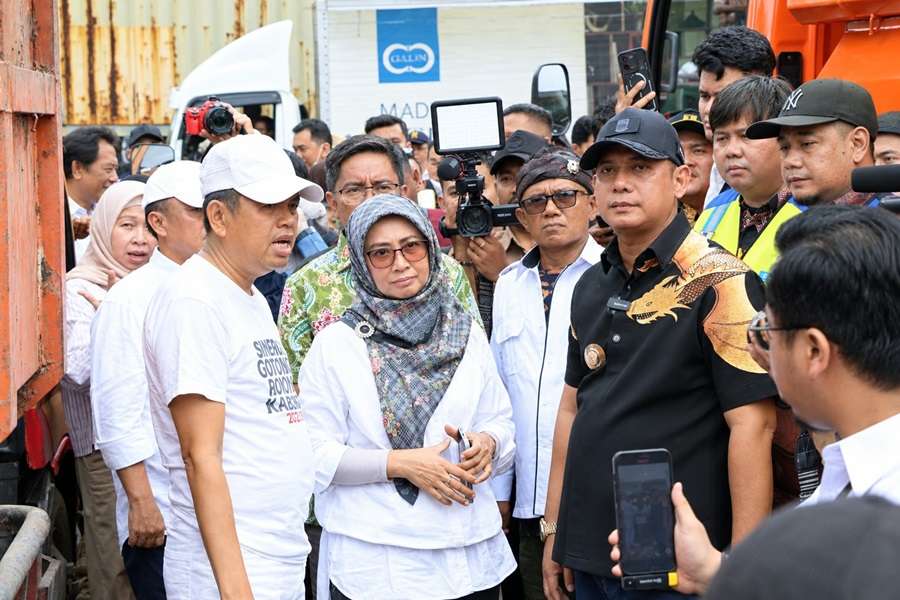
PORTALJABAR, BEKASI REGENCY - Addressing the problem of garbage piles in the KM 19 area, Jakarta - Cikampek toll road (Japek Toll), Bekasi Regent Asep Surya Atmaja together with West Java Governor Dedi Mulyadi (KDM) went directly to the location to see the condition of the Jambe River, on Friday (10/30/2026).
Both ensured accelerated handling through river normalization, waste transportation, and cross-regional coordination so that waste issues from upstream to downstream can be handled in an integrated manner.
Bekasi Regent Asep Surya Atmaja said that waste management in the Jambe River requires cooperation from several parties, considering that the problem is related to the flow of waste from upstream to downstream areas.
According to him, the waste polluting the Jambe River is suspected to originate from the Sumur Batu and Bantargebang areas. The overcapacity of waste management in these areas is a problem that needs to be addressed collectively to prevent waste from continuing to be carried into Bekasi Regency.
"To address this, the local government has allocated a budget of around Rp 2.3 billion for normalization activities. After normalization, the collected waste will be removed and handled in collaboration with the River Basin Office (BWS) and then transported to a management location in accordance with cross-regional coordination," said Asep.
He added that handling is not sufficient only at the dumping site; it must also address the source of the problem upstream. Therefore, the Bekasi Regency Government has coordinated with the Bekasi City Government regarding plans to install trash nets and improve wastewater treatment plants (WWTPs).
"The Jambe River flows into the CBL River. Therefore, waste and water pollution issues must be addressed at the source. We hope that improvements in the upstream area, including the installation of waste nets and the arrangement of wastewater treatment plants (WWTP), can be implemented immediately to prevent waste from continuing to be carried downstream," he said.
Asep stated that his office had also discussed the mitigation measures taken with the Head of the West Java Provincial Environmental Agency. As directed by the Governor of West Java, all mitigation steps will be implemented according to the agreed-upon timeline.
"We are committed to carrying out all stages according to schedule. The Bekasi City Government has also been asked to provide details of the work stages and completion dates so that this process can be measured, coordinated, and can be followed up together," he said.
Meanwhile, Syafri Donny Sirait, Head of the Bekasi Regency Environmental Agency (DLH), stated that the volume of illegal waste accumulated in the KM 19 area is estimated to reach 1,200 cubic meters. The handling is being carried out collaboratively, involving the Bekasi Regency Government, Bekasi City Government, the West Java Provincial Water Resources Agency (PSDA), and relevant parties from Jakarta.
To support waste collection, Bekasi Regency has prepared a fleet of approximately 50 to 60 dump trucks, scheduled to operate on Sundays. This scheduling is designed to ensure that waste collection activities do not disrupt routine waste collection services to the public.
"For Bekasi Regency, we've prepared around 50 to 60 vehicles on Sundays. Pickups are scheduled for that day to ensure waste management services to the public continue on weekdays," explained Syafri.
He added that the waste transported from Bekasi Regency is planned to be taken to Aspex Kumbong. Through coordination with the Ministry of Environment, the Governor of West Java, and the TPST management, the waste transport facility has received support in the form of a waiver of tipping fees.
In addition to transportation, the Bekasi Regency Environmental Agency also highlighted the need to build permanent waste retention infrastructure at the zero kilometer point of the river boundary between Bekasi City and Bekasi Regency.
According to him, the existing garbage barriers haven't been able to hold back all the trash when the volume of traffic increases. As a result, trash continues to flow into Bekasi Regency and is trapped around the bridge, eventually piling up at kilometer mark 19.
"We need a permanent concrete waste gate at the zero kilometer border. That way, if waste originates upstream, it can be contained from the start, and its handling becomes the responsibility of the area of origin," he said.
He hopes the current cross-regional efforts will strengthen coordination in waste management from upstream to downstream. This will prevent similar issues from recurring and increase the burden on waste management in Bekasi Regency. (Bekasi Regency Communications and Information Office/rka)
 Share News Via
 facebook
 twitter
 whatsapp
 email