

PORTALJABAR, BANDUNG CITY - The Bandung City Government (Pemkot) has prepared three strategic steps to address the traffic congestion problem, which has been a major complaint of residents and a major challenge for the tourism sector and regional economic growth.
This was conveyed by the Mayor of Bandung, Muhammad Farhan, during a special interview with B-Tv's "Berita Satu Special" with the theme One Year of Regional Heads, Central & Regional Synergy, Friday (20/2/2026).
Farhan acknowledged that Bandung City has significant tourism potential. However, various classic issues such as waste and traffic congestion remain challenges, impacting the achievement of regional growth targets.
"There are three things that will be done to deal with this traffic jam," said Farhan.
The first step is to increase the capacity and quality of road infrastructure. The Bandung City Government is collaborating with the central and provincial governments on road construction and repairs.
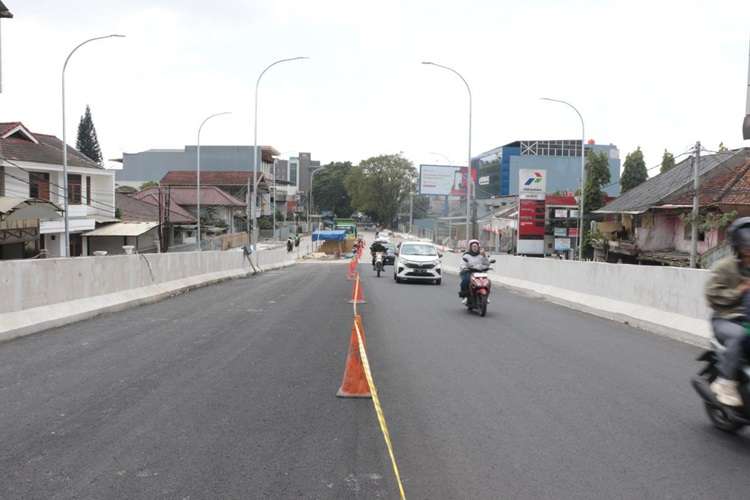
He said the central government had completed two main flyovers, but six additional flyovers were still needed to be built on the railway tracks and three connectivity bridges around the KCIC Tegaluar Station and the Gedebage area.
In addition, improving the quality of public street lighting (PJU) is also a concern, especially in the eastern area of Jalan Soekarno-Hatta, which is considered to still be a major problem area.
The second step is the implementation of artificial intelligence-based technology through the ATCS (Automatic Traffic Control System). This system is expected to be able to manage traffic more adaptively and efficiently.
Farhan said that implementing the program was not easy because it required careful planning and cross-government coordination.
"It's not easy because the procurement process requires very good planning, as it involves three large organizations: the central government, the provincial government, and the city government," he explained.
The third step is strengthening mass transportation. The Bandung City Government, along with the Ministry of Transportation and with support from the World Bank, is currently promoting two major programs: the development of Bus Rapid Transit (BRT) with the Directorate General of Land Transportation and a feasibility study for LRT with the Directorate General of Railways.
According to Farhan, the BRT is designed to serve the east-west corridor, while the LRT will connect the north-south route. This scheme is expected to become the backbone of Bandung City's mass transportation system.
However, he stated that revitalizing public transportation (angkot) remains a crucial part of the new system. Angkot must transform into feeder buses for the BRT and LRT to ensure optimal operation of the integrated transportation system.
Farhan also highlighted the fundamental problem of transportation in Bandung, which has not seen any route changes since 1984. The public's dependence on private vehicles is considered too high, so revolutionary steps are needed to restore residents' interest in using public transportation.
"Frankly, the quality of public transportation in Bandung City is currently very inadequate," he said.
Farhan said that synergy between the central, provincial, and city governments is key to accelerating the realization of these various programs.
According to him, transportation improvements are not only intended to alleviate congestion but also to support Bandung's future economic growth and tourism competitiveness. (Bandung City Communications and Information Service/rka)
 Share News Via
 facebook
 twitter
 whatsapp
 email
email