

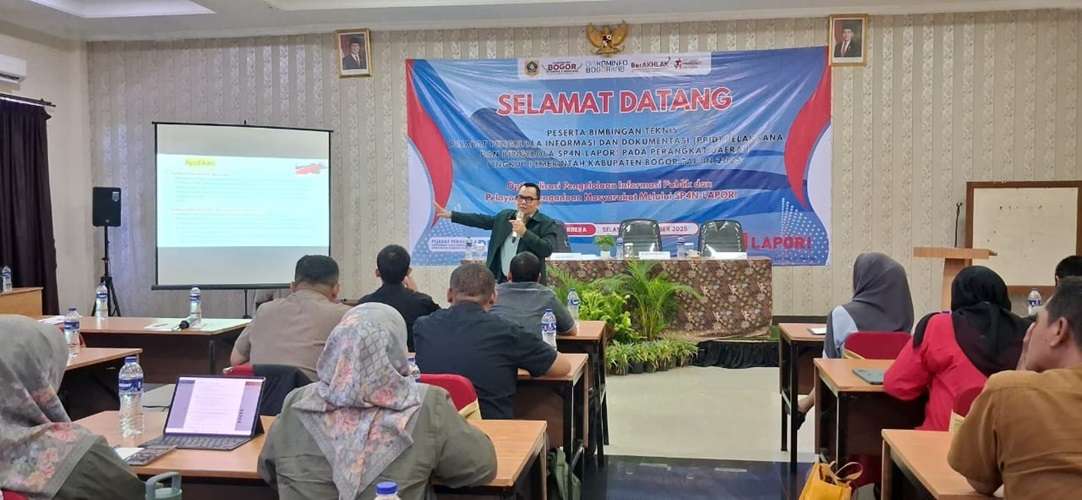
PORTALJABAR, BOGOR REGENCY - The Bogor Regency Government, through the Bogor Regency Communication and Informatics Office (Diskominfo), held a Technical Guidance for Information and Documentation Management Officers (PPID) Implementing and Managing SP4N-LAPOR! for regional officials, which took place at the Gerbera Hotel on Tuesday (2/12/2025). The technical guidance carried the theme "Optimizing Public Information Management and Public Complaints Services Through SP4N-LAPOR!".
This activity is a concrete manifestation of the Bogor Regency Government's commitment to improving the quality of public information governance and public complaint services, especially amidst the increasingly rapid pace of information technology development and digital transformation.
The Head of the Bogor Regency Communications and Information Office, Bambang Widodo Tawekal, stated that the government must adapt to changing times and rising public expectations, particularly in the digital era, when people are increasingly critical, tech-savvy, and have high expectations for the speed, transparency, and quality of government services.
"Information no longer flows one way. The public demands easy, fast, and reliable access. Likewise, public complaints mechanisms must be handled professionally and in an integrated manner," he said.
He emphasized that the existence of the Public Information Reporting Agency (PPID) and the national SP4N-LAPOR! system plays a strategic role in realizing an open and responsive government. The PPID is tasked with ensuring that every request for public information is submitted transparently and in accordance with regulations, while SP4N-LAPOR serves as an official, nationally integrated public complaints channel.
Through SP4N-LAPOR!, the public can not only convey complaints, but also aspirations and input which are important materials in improving public services.
"The challenge is how we can provide a rapid, solution-oriented, and accountable response. This certainly requires increased human resource capacity, regulatory understanding, and the ability to optimally utilize technology," Bambang added.
He further emphasized that digital transformation is not only about system updates, but also a shift in mindset. Civil servants are required to be more adaptive, innovative, and open to change. The Public Information and Transaction Reports (PPID) and SP4N-LAPOR administrators must be at the forefront of providing the best possible service to the public.
Through this technical guidance, participants are expected to deepen their understanding of public information governance, the SP4N-LAPOR service flow, and strategies for improving service quality.
With these provisions, regional apparatus are expected to be able to optimize information services and public complaints amidst the dynamics of ever-evolving public needs.
On that occasion, Bambang also invited all regional apparatus to strengthen collaboration and coordination in optimizing complaint services.
"The success of SP4N-LAPOR and public information transparency is not only determined by the sophistication of the system, but by our shared commitment to serving the public better," he stressed.
Bambang Widodo Tawekal expressed his gratitude to all parties who supported the implementation of this activity.
He hopes that this Technical Guidance can be a concrete step in increasing the capacity of the apparatus, strengthening government transparency, and realizing more modern, responsive, and reliable public services in Bogor Regency.
Furthermore, the Coordinator for Complaint Facilitation and Information Management/Senior Expert Public Relations Officer at the Ministry of Home Affairs, Rega Tadeak Hakim, emphasized that the Public Information and Communications Agency (PPID) plays a strategic role in bridging the public's information needs, while ensuring that every complaint is conveyed quickly, accurately, and accountably through SP4N-LAPOR. He believes that the quality of government communication is crucial for public trust.
"SP4N-LAPOR is not just a complaint channel, but a crucial instrument for building transparency and government responsiveness. The Public Information and Communications Agency (PPID) must be able to manage information professionally, in a structured manner, and oriented toward public service," he concluded.
Then, Professor of Communication Science at UIN Sunan Gunung Djati Bandung, Mahi M Hikmat explained that public information services are a mandate of law and an obligation of all public bodies to realize transparency, accountability, and excellent service to the public.
He emphasized that information transparency is not only about providing data, but also ensuring that information is well managed, easily accessible, and delivered appropriately and correctly.
Mahi further discussed various important aspects related to resolving information disputes. According to him, information disputes arise from a misunderstanding between public bodies and information requesters. Therefore, it is crucial for PPIDs to understand information classification, service operational standards, and the complaint and dispute resolution mechanisms at the Information Commission.
"The Public Information and Communications Agency (PPID) must be at the forefront of providing fast, accurate, and accountable public information services. With a strong understanding, the potential for information disputes can be minimized," he said. (Bogor Regency Communication and Information Office/Rani)
 Share News Via
 facebook
 twitter
 whatsapp
 email
email