

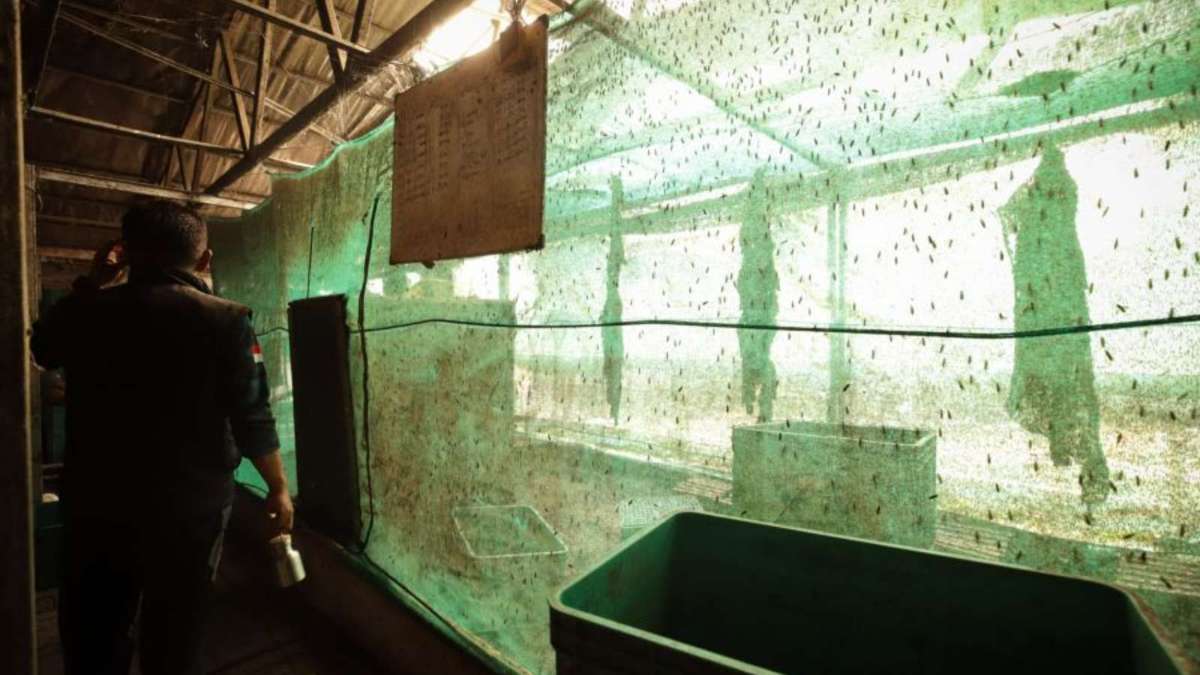
PORTALJABAR, BANDUNG CITY - The Gedebage Temporary Waste Processing Site (TPSS) in Bandung City continues to develop source-based waste processing by relying on maggotization as one of the main methods to reduce the volume of organic waste.
Gedebage TPSS Manager, Rudi Rudiana, said that the waste entering the facility comes from various sources, ranging from domestic waste from residents, commercial waste to waste support from the Gaslah program.
Upon arrival at the Gedebage TPSS, the waste first undergoes a sorting process using machines. This process then categorizes the waste into several categories based on its characteristics and processing potential.
"The first is organic waste for maggot feed. The second is composted organic waste, the third is high-value or scrap, the fourth is low-value, the fifth is RDF material, and the last is compost," said Rudi when met at the Gedebage TPSS, Wednesday (19/8/2026).
According to him, the incoming waste is predominantly composed of organic materials that can be used as maggot feed, accounting for approximately 50 to 60 percent.
Meanwhile, around 20 percent is organic material for compost. Residue is around 15 percent, while scrap, low-value materials, and RDF are below five percent.
Specifically, for organic waste to be used as maggot feed, managers don't feed it directly to the maggots. The waste first undergoes a fermentation process for two to four days.
This process is carried out to reduce negative bacteria and substances that have the potential to interfere with the maggotization process.
"So, we ferment it first to maintain and eliminate harmful bacteria, especially chemicals. We wait at least two to four days before feeding it to the maggots," he said.
Through the maggotization process, the Gedebage TPSS is currently capable of reducing approximately five to eight tons of organic waste per day. This capacity is targeted to be increased to 10 tons per day, depending on the availability of organic waste, particularly food waste.
Overall, the Gedebage TPSS can process approximately 15 to 20 tons of waste per day. This processing activity has been running for approximately three to four years.
Rudi said that the sustainability of waste processing at the Gedebage TPSS is supported by three main factors: continuity of waste supply, workforce support, and consistent management.
"If the waste is supportive, we can maximize our efforts. Sometimes we actually run out of waste, especially food waste, which is needed for maggotization," he said.
In the maggotization area, the Gedebage TPSS has 176 biopons measuring 2.5 meters x 2.5 meters. Approximately 90 percent of the biopons can be used for maggotization, while the remainder is used for temporary storage of maggot feed.
According to Rudi, maggotization at the Gedebage TPSS isn't solely intended for cultivation purposes. Maggots function more as biological "machines" to reduce organic waste.
Therefore, the continuity of the maggot cycle is important so that the waste reduction process does not stop.
The maggots produced are also used to support maggot farms at the sub-district level. If there is excess production, the maggots can be distributed or used by farmers around the Gedebage TPSS.
Meanwhile, the final result of the maggotization process in the form of kasgot is used as fertilizer.
Rudi said that his party had previously conducted a collaborative test on the use of kasgot with ITB alumni from the class of 1974 in the Singaparna area of Tasikmalaya.
The test results show that the use of kasgot has the potential to reduce fertilizer costs while increasing crop yields compared to the use of chemical fertilizers.
"Thank God, yesterday we tested the collaboration with ITB '74 alumni. The results were amazing, saving tens of millions in fertilizer costs and producing a higher yield than using chemical fertilizers," he said.
In the future, Rudi hopes that the organic waste processing system through maggotization can be developed in a decentralized manner in various areas of Bandung City.
According to him, waste processing should be carried out as close as possible to the source of the waste so that not all the waste has to be taken to one location.
He proposed strengthening processing facilities in the East, South, North and West Bandung regions.
"Decentralization means there are polling stations in East Bandung, South Bandung, North Bandung, and West Bandung. So, voting will be done in each region. There will be no long-distance crossings," he said.
(Bandung City Communications and Information Service/rka)
 Share News Via
 facebook
 twitter
 whatsapp
 email
email