

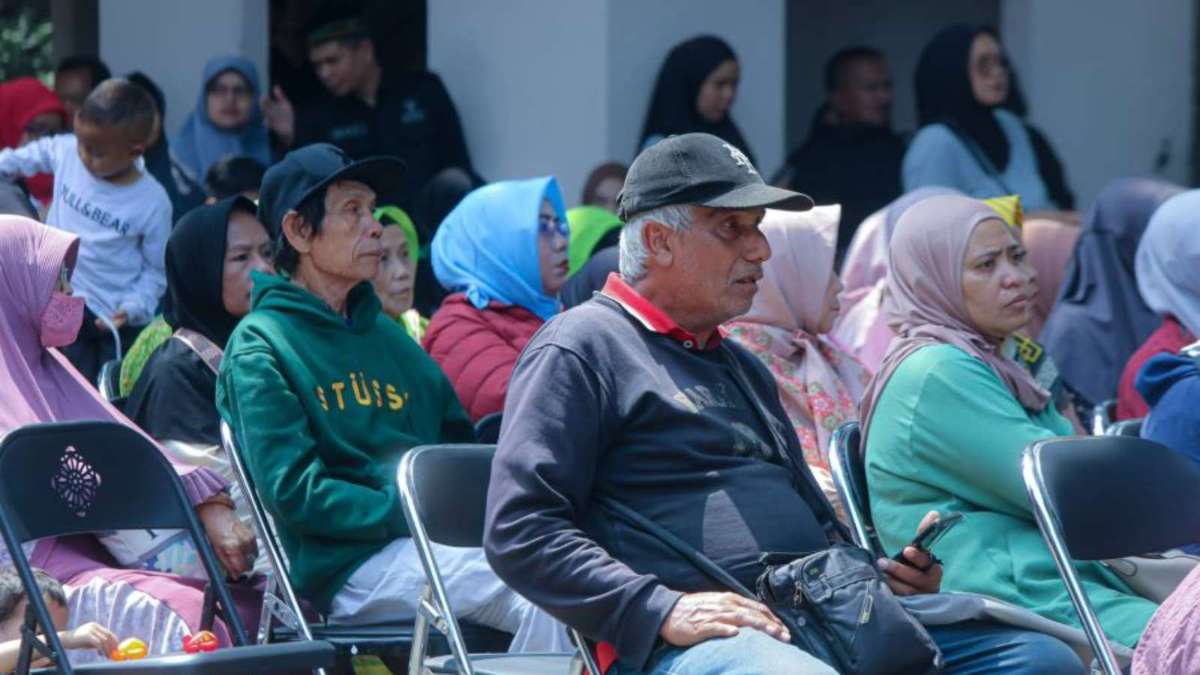
PORTALJABAR, BANDUNG CITY - Bandung Mayor Muhammad Farhan encouraged zakat management not to stop at distributing aid, but to be able to provide a real impact on improving community welfare.
This means that every aid distributed needs to have a measure of success that can be seen from changes in the condition of the beneficiary.
This was conveyed by Farhan when attending the symbolic handover of assistance from the Bandung City Baznas for the August 2026 period while also witnessing the signing of a number of cooperation agreements between the Bandung City BAZNAS and a number of regional apparatuses and institutions in Bandung City at the PCNU Office, Jalan Sancang, Thursday (20/8/2026).
According to Farhan, zakat management needs to be directed towards empowerment and poverty alleviation. Therefore, the impact of assistance provided to those entitled to receive it must be measurable.
"If we provide assistance to A, within six months his life will improve or not. There must be a measure," said Farhan.
He described this approach as impact measurement. He believes that success is measured not only by the amount of funds disbursed, but also by the changes experienced by beneficiaries after receiving assistance.
"What counts is not just the return on investment, but also the impact," he said.
Farhan believes this effort requires collaboration from various parties. The government's reach is limited because its structure stops at the sub-district level. Meanwhile, religious institutions, community organizations, zakat collection agencies, religious study groups, and even regional legislative council (DPRD) networks have a closer reach to the community.
"That's where the most meaningful partnership between government structures and the institutions I mentioned earlier lies," he said.
Therefore, Farhan appreciates the cooperation built by the Bandung City Baznas with a number of parties, starting from the Social Service, the Population and Civil Registration Service, the PKK Mobilization Team, the Posyandu Advisory Team, the Healthy Bandung Forum, to UIN Sunan Gunung Djati Bandung.
This collaboration includes, among other things, the use of the National Socio-Economic Single Data (DTSEN) in the distribution and utilization of zakat, verification and validation of mustahik population data, family empowerment, Posyandu services, improving public health, as well as research on the impact of zakat and human resource development.
Farhan believes this integration is crucial to ensure that aid is provided more effectively and that beneficiaries are encouraged to become more independent.
Meanwhile, Farhan also encouraged increased zakat collection capacity in Bandung City. He targeted annual collection by the Bandung City Zakat Agency (Baznas) to reach Rp 100 billion within the next three years.
"So, in the next three years, we must be able to reach Rp100 billion per business cycle per year," he said.
Farhan stated that the Bandung City Government will assist in strengthening this collection effort. One way is by exploring the use of sharia-compliant investment instruments, after he took members of the Bandung City Zakat Agency (Baznas) to the Indonesia Stock Exchange to learn about sharia-compliant investment management.
According to him, the development of zakat needs to be carried out with a creative approach, both in collection and distribution, as long as it still pays attention to the principles and proper governance.
Meanwhile, the Head of the Bandung City Baznas, Momon Imron, said that from January to July 2026, the Bandung City Baznas had collected funds amounting to IDR 16.347 billion.
Around 92 percent of the collection comes from zakat, especially income zakat, while the remainder comes from infaq, alms, and other social and religious funds.
During the same period, the Bandung City Baznas distributed approximately Rp15.2 billion, or approximately 95 percent of the funds collected. The distribution was carried out through five main programs: education, health, economics, humanitarian assistance, and religious outreach.
During the August 2026 aid distribution period, the Bandung City Baznas provided assistance to approximately 470 beneficiaries totaling approximately IDR 1.73 billion.
The assistance includes basic food packages, basic education up to university, business capital, medical expenses, BPJS arrears, basic living costs, medical equipment, assistance for uninhabitable houses, disaster assistance, and rental arrears.
Momon hopes that the various programs and collaborations carried out by the Bandung City Baznas together with the Bandung City Government and a number of institutions can further increase public trust, especially muzaki and munfik, to distribute their zakat and infaq through the Bandung City Baznas.
"Hopefully, what we are doing today will further increase the trust of the muzaki and munfik who have entrusted their zakat and alms to Baznas. Hopefully, more muzaki and munfik will entrust their zakat and alms to Baznas Bandung City for programs to improve and alleviate poverty in Bandung City," said Momon.
(Bandung City Communications and Information Service/rka)
 Share News Via
 facebook
 twitter
 whatsapp
 email
email