

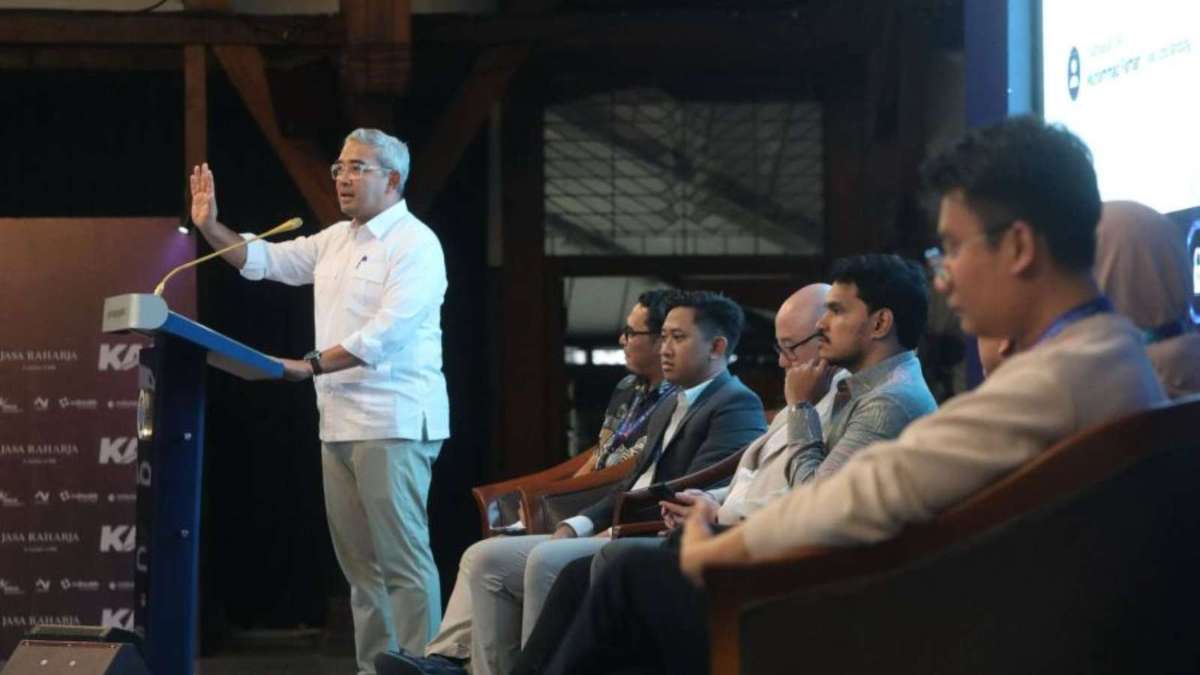
PORTALJABAR, BANDUNG CITY - Bandung Mayor Muhammad Farhan emphasized the importance of data readiness and governance before the government adopts artificial intelligence (AI) technology.
This was conveyed by Farhan when he was a speaker at AIIF Panel 8 entitled AI Government & Public Services, Thursday (27/8/2026).
According to him, digital transformation of government is not enough to simply introduce the latest technology, but must ensure that the technology has a supporting system and produces a real impact on society.
Farhan reminded the government not to get caught up in the Fear of Missing Out (FOMO) or to adopt technology simply because it's trending.
He cited the example of 4K CCTV cameras, which were initially promoted for their facial recognition and various analytical features. However, the technology wasn't optimal because the necessary back-end system wasn't available.
"You have to be very careful in the digital world, don't let FOMO get the better of you. If we can recognize someone's face, then what? The city government doesn't have the authority to investigate that person," said Farhan.
According to him, government technology utilization must also consider legal aspects, authority, and personal data protection. Therefore, before widespread use of technology, administrative readiness and inter-agency cooperation mechanisms are required.
"Things like that are what we call administrative readiness. It's boring. It's very, very boring. But it will close all the legal loopholes in any technology used," he said.
Farhan explained that in Bandung City's digital transformation, the first step is to ensure the availability of unified data and governance. After that, the government will discuss the technology and the concrete impact it aims to achieve.
One of the foundations is the collection of regional data from 1,597 neighborhood units (RW) in Bandung City. The Bandung City Government collected 58 indicators regarding regional conditions through data collection at the neighborhood unit (RT) and neighborhood unit (RW) levels.
The data was then verified with the Bandung City Central Statistics Agency (BPS). From this process, the Bandung City Government began developing a system that could display regional conditions in a more integrated manner.
"This is part of how standardizing data can then be our starting point in governance, not technology," said Farhan.
He stated that the process is still under development. Once data integration is underway, the Bandung City Government will move towards utilizing AI recommendations to aid decision-making.
According to Farhan, one example of the use of data in decision-making can be seen in the issue of waste management.
Based on regional data, only 490 of 1,597 neighborhood units (RW) have been able to separate their waste. This situation is one of the reasons why the Bandung City Government implemented the Gaslah program, which places sorting officers at the neighborhood unit (RW) level.
However, the policy was also immediately evaluated based on data. After six months of implementation, the evaluation results showed that each neighborhood unit (RW) could only sort a maximum of around 40 kilograms of waste per day.
When multiplied by all neighborhood units (RW), the sorting capacity is around 60 tons per day. This figure is still far from Bandung City's waste production, which reaches around 1,800 tons per day, with approximately 60 percent of this being organic waste.
Farhan believes that data and technology must be used to assess the effectiveness and consequences of a policy, including from a budgetary perspective.
He also cited the example of deploying one sorting officer in 1,597 neighborhood units (RW) requiring a budget of approximately Rp28 billion per year. Therefore, every policy needs to be thoroughly calculated before being implemented more widely.
"We must calculate the consequences of every policy in advance and prepare for them later. Therefore, back-end and forecasting become very important before we move on with technology," he said.
The Bandung City Government is also developing various prototypes to support the validation and decision-making process. One such application is the Teh Eva, or Electronic Validation Application, which is still in beta.
Farhan said the prototyping approach allows each innovation to be tested initially at a relatively low cost. Once proven to work and provide benefits, the technology can be developed and disseminated more widely.
"After all, we're starting from data governance so that it has a real impact on society," said Farhan.
For your information, the AI Indonesia Initiative Forum will take place on August 26-28, 2026. You can watch it on the SCCIC Living Lab YouTube channel.
(Bandung City Communications and Information Service/rka)
 Share News Via
 facebook
 twitter
 whatsapp
 email
email