

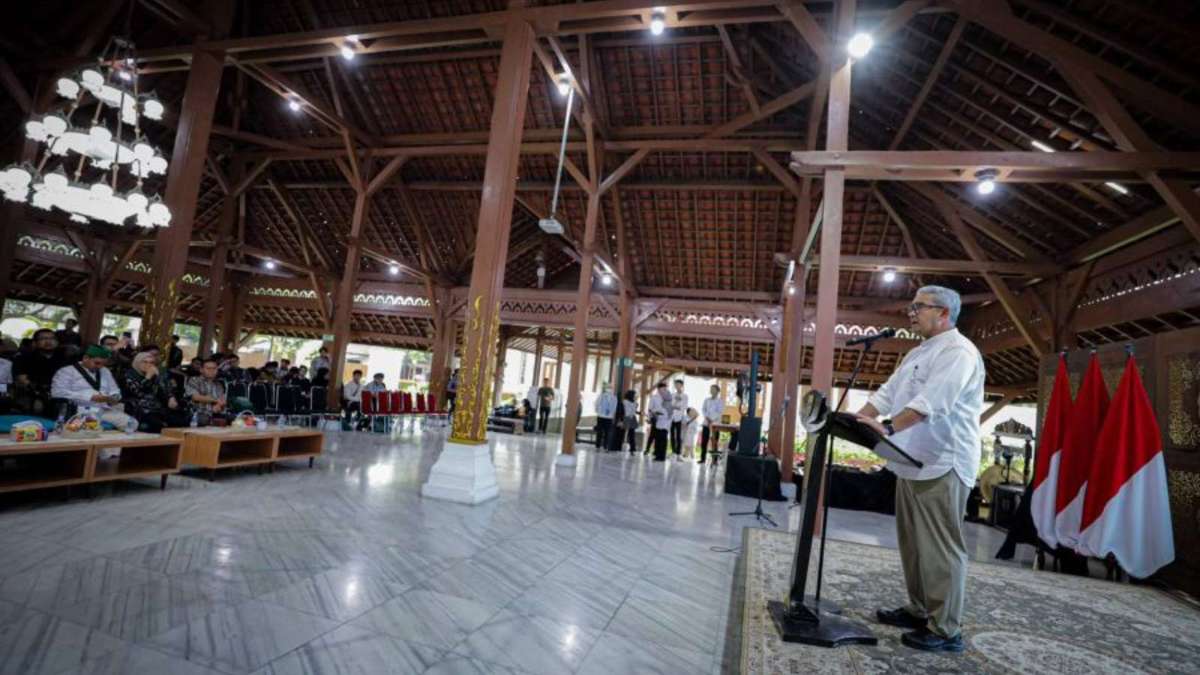
PORTALJABAR, BANDUNG CITY - Bandung Mayor Muhammad Farhan believes that students play a crucial role as critical partners with the government in overseeing regional development. Criticism stemming from scientific studies and public awareness is crucial for improving every public policy.
To that end, he invited the Islamic Students Association (HMI) to continue to maintain the tradition of critical thinking and become a strategic partner of the government in overseeing the development of the City of Bandung.
This was conveyed by Farhan when attending the Inauguration of the Management of the Islamic Students Association (HMI), the HMI-Wati Corps (KOHATI), and the HMI Bandung Branch Training Management Agency (BPL) for the 2026–2027 Period at the Bandung City Hall, Friday (31/7/2026).
Farhan congratulated all the newly inaugurated administrators. He hoped the new leadership would continue HMI's intellectual tradition while making a tangible contribution to the development of Bandung City.
"I congratulate all the heads and administrators of the Bandung Branch of HMI, KOHATI, and BPL. Hopefully this mandate can be carried out well and bring benefits to the community," he said.
Farhan believes the government cannot act alone in formulating and implementing public policy. Therefore, the existence of student organizations like HMI is essential as partners capable of providing objective criticism and input.
"HMI must always position itself as a student group that holds critical views of the government, whether at the city, provincial, or central level. The government cannot be left to act alone. It must always have critical partners," he said.
According to Farhan, every public policy has limitations or blind spots that often only become apparent when tested by the public and academics. Therefore, student voices are a crucial instrument in evaluating the direction of development.
"By listening to students' critical voices, the government has a tool to test whether the policies it creates truly address the needs of the community. No policy is perfect; there's always room for improvement," he said.
He also encouraged students to continue presenting creative ideas based on real-world conditions. He believes that student organization cadres must be able to produce a generation that is not only critical but also offers solutions to various national problems.
On that occasion, Farhan outlined several challenges still facing the city of Bandung. Despite its high economic growth and a per capita Gross Regional Domestic Product (GRDP) approaching US$10,000, the city still faces an unemployment rate of around 7.2 percent and a Gini ratio of 0.42.
"We still have a lot of work to do. Our target is to reduce inequality to approach the national average of 0.36. This is certainly not easy and requires collaboration from all parties," he said.
Farhan also highlighted environmental issues that remain a serious challenge. According to Laci RW data verified with the Central Statistics Agency (BPS), more than a quarter of homes in Bandung City lack proper waste management systems, resulting in a significant amount of domestic waste being dumped directly into rivers.
As a result, environmental quality and raw water sources continue to experience pressure, while the clean water service coverage of Perumda Tirta Wening Kota Bandung has only reached around 38 percent.
He also touched on the fiscal challenges facing local governments, ranging from high personnel costs to a shortage of approximately 1,700 elementary and junior high school teachers. In the housing sector, homeownership remains below 50 percent, prompting the government to explore various alternatives, including the development of vertical housing.
Farhan encouraged students to not only be active in the classroom, but also to be present in the community so they can understand the problems directly.
"Being a student is the best time to test what you've learned against real-world situations. Listen, feel, and understand their problems so that the solutions you offer are truly relevant," he advised.
He is optimistic that HMI cadres will become part of Indonesia's future leaders. Therefore, the cadre development process must be continuously strengthened to produce leaders with integrity, adaptability, and social awareness.
Meanwhile, the General Chair of the HMI Bandung Branch for the 2026–2027 Period, Darlingga Prasetio, stated that his organization is committed to becoming a thought laboratory capable of providing policy recommendations for the Bandung City Government.
According to him, various problems such as waste management, flooding, street lighting, and the increase in crime at night must be answered through a comprehensive study.
"HMI is present as the epicenter of the movement and a laboratory for social sciences. We want to present policy recommendations that can make a real contribution to solving Bandung City's problems," he said.
Darlingga added that, in addition to implementing various work programs, the HMI Bandung Branch will also strengthen the cadre development process through the implementation of a Grand Training which is planned to take place in September 2026.
The program is expected to produce cadres who are ready to continue the leadership baton and contribute to the development of the City of Bandung and Indonesia.
(Bandung City Communications and Information Service/rka)
 Share News Via
 facebook
 twitter
 whatsapp
 email
email