

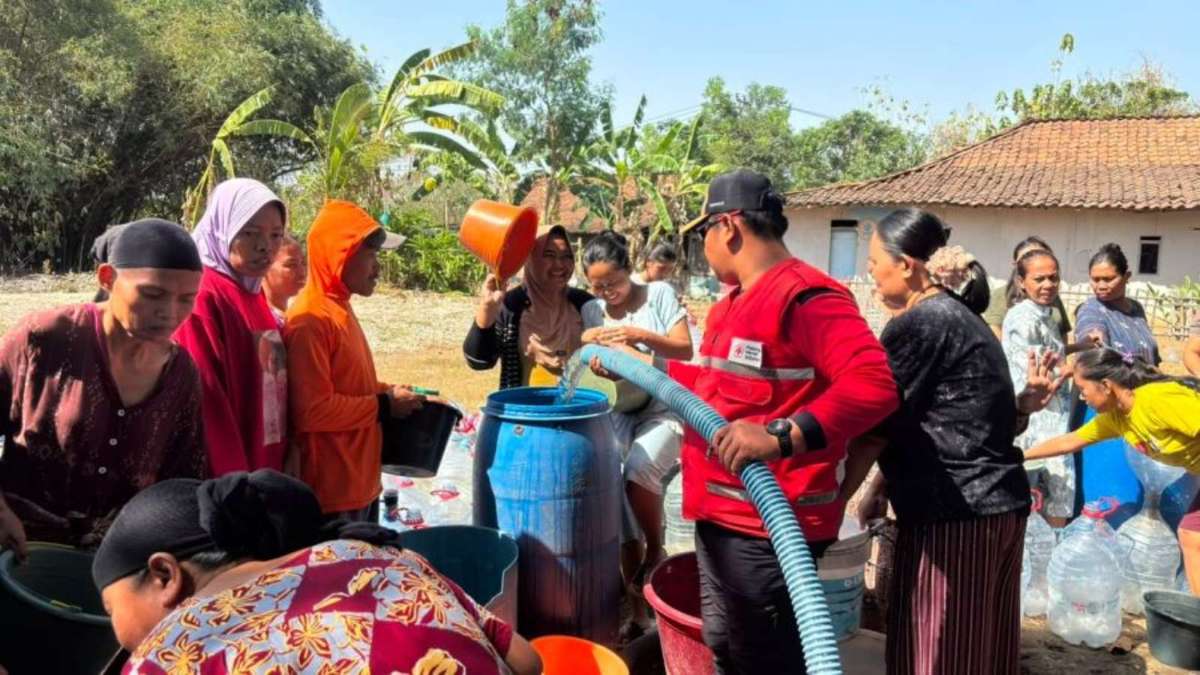
PORTALJABAR, BEKASI REGENCY - The Indonesian Red Cross (PMI) of Bekasi Regency operates a water treatment plant to process water sources into clearer and safer water before distributing it to drought-affected communities.
The water treatment uses water from Telaga Hejo, Tegal Kadu Hamlet, Sirnajaya Village, Serang Baru District. The water source was selected after undergoing laboratory testing and was deemed of sufficient quality to be processed and used as community water aid.
The Public Relations Officer of the Bekasi Regency PMI, Achmad Syarif, said that the water source from Telaga Hejo is one of the points that is considered capable and very suitable to support the clean water production process.
"The water treatment facility currently used by the Bekasi Regency Indonesian Red Cross (PMI) purifies water so it can be distributed directly to residents. We source the water from Telaga Hejo, Tegal Kadu Hamlet, Sirnajaya Village, Serang Baru District," said Syarif when met at the location in Tegal Kadu, Sirnajaya Village, Serang Baru District, on Monday (September 7, 2026).
According to him, the use of this water source was also based on laboratory testing results. The results showed no contamination, and its clarity was deemed quite good.
"The clarity is also good. That's why we use it for processing and then distributing it to the community," he said.
During the treatment process, PMI continues to implement additional safety measures by adding chlorine. This process helps kill microorganisms or germs that may still be present in the water, including Escherichia coli (E. coli) bacteria.
"In terms of safety, the PMI laboratory is trying to add chlorine to kill germs in the water, one of which is E. coli bacteria," explained Syarif.
Technically, the treatment process begins by drawing water from Telaga Hejo using a pump system to the initial reservoir. The water then flows into the union tank, which serves as the initial reservoir before entering the filtration stage.
"First, we draw or pump water from Telaga Hejo as the water source, then we transfer it to the first reservoir. There's a union tank there, which is technically used for initial storage," he explained.
Once in the union tank, the water is then channeled to a filtration machine. This machine filters the water to improve its clarity before it enters the next storage stage.
Syarif explained that the filtration machine used was equipment belonging to the Central PMI which was loaned and brought to Serang Baru to support the process of providing water services to the community.
"From the first reservoir, we filtered the waste using a filtration machine. This machine belongs to the Indonesian Red Cross (PMI) headquarters, and we borrowed it and brought it to Serang Baru for filtration," he said.
Although Telaga Hejo's water source has had a fairly good level of clarity from the start, a filtration process is still carried out as an additional step to ensure the water produced is of better quality before being distributed.
After going through the filtration process, the water is then channeled to the water blender, which serves as a temporary storage area before the water is raised or channeled to the storage tanks.
"After filtration, we collect the water in a water blender before pumping it into the water tanks," said Syarif.
The storage tanks used in the distribution process can be either PMI tanks or those owned by the Regional Disaster Management Agency (BPBD). According to Syarif, storage capacity is also a factor in determining the smooth flow of daily water production.
"You can use PMI water tanks, or you can also use BPBD water tanks. If there are tanks from the community who want to help, those can also be used. And for agencies or companies willing to donate tanks or gallons, PMI is ready to accept them," he said.
In terms of processing time, one process until the reservoir is filled takes approximately two to three hours. This timeframe depends on the water collection, filtration, and transfer to the final reservoir.
"From the time it's pumped out to the final storage area, it takes about two to three hours for the tank to be full and ready for use," he said.
Meanwhile, the Bekasi Regency PMI's water treatment capacity is around 50,000 liters of water per day. With maximum operation and considering the capacity of the reservoir and distribution fleet, production can reach around 100,000 liters per day.
"In a single process, we can produce at least 50,000 liters per day. At maximum capacity, it's usually around 100,000 liters," explained Syarif.
He added that production capacity depends not only on the capability of the water treatment machines, but also on the availability of storage facilities and fleets to distribute water to the community.
"If the storage tank is full, we'll immediately transfer the cargo to the fleet so that the storage capacity can be restored," he said.
The water treatment operation has been ongoing for five days, ending Monday (September 7, 2026). The operation is part of the Bekasi Regency Red Cross's efforts to meet the community's water needs amidst the drought in several areas.
With this system, water from local sources is not only collected, but first goes through a series of processing stages including initial collection, filtration, further collection, and a chlorination process before being used for community needs.
Syarif ensures that the processing process is carried out with attention to water quality and safety aspects, starting from selecting the water source to the final stage before the water is distributed.
"So, we first verify the water source, then filter it and treat it with chlorine before finally distributing it to the public. Don't forget, for those who will be consuming it, boil the water first," he concluded.
(Bekasi Regency Communications and Information Service/rka)
 Share News Via
 facebook
 twitter
 whatsapp
 email
email