

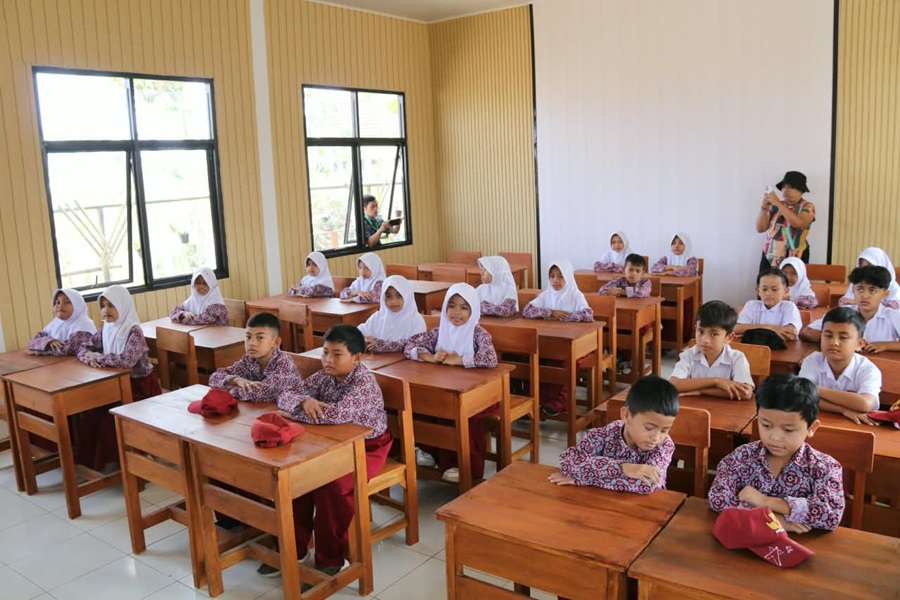
PORTALJABAR, GARUT REGENCY - The Garut Regency Government (Pemkab) welcomed and appreciated the inauguration of the construction of classrooms and toilets made from plastic waste initiated by the Bakti Barito Foundation at SDN 3 Sukanegla, Garut City District, Garut Regency, Wednesday (30/9/2026).
The Regional Secretary of Garut Regency, Nurdin Yana, expressed his gratitude for the concern of the Bakti Barito Foundation in collaboration with Star Energy in helping to provide educational infrastructure in Garut.
"Yes, of course, the Bakti Barito Foundation is not only in this one context, the Bakti Barito Foundation has already built 40 buildings in collaboration with Star Energy," he said.
He also ensured that the structure of the new classroom building was safe, strong, and sturdy because it used a locking system resembling Lego blocks reinforced with pipes in the middle.
"I think it's ideal, if you look at the four products mentioned earlier, they're very good and very strong. They're like Lego, so the blocks are locked together, so this building, God willing, is strong. Then, in the middle, there's a kind of pipe to strengthen the structure," said Nurdin Yana.
The inauguration was also attended by the Singaporean Ambassador to Indonesia, Kwok Fook Seng. He praised the innovative initiative as an early education for children, helping them understand the importance of recycling, starting in school and then implementing it in their families.
"I think we have made it achievable. You saw the demonstration from the children earlier on how to recycle. I think it's important to start from that," he said.
Fifi Pangestu, Executive Director of the Bakti Barito Foundation, emphasized that building school facilities from plastic waste would not be optimal without collaboration from various parties. She stated that the issues of waste and climate change require a joint effort involving the private sector, educational institutions, the community, and the government.
"We need to collaborate with all stakeholders, from the CSR of each company to schools, households, and the government, to ensure the success of this pilot project," he said.
Bakti Barito Foundation Director Dian A. Purbasari explained that the initiative stemmed from the need for SDN 3 Sukanegla, which faced a shortage of classrooms due to its growing student population. Previous construction plans had also been delayed due to several earthquakes.
To address this need, the foundation collaborates with partners through the Green Guardians program for climate change education. One way to achieve this is by providing waste management solutions that children can see firsthand, so they understand that waste has value.
"So the children can see that their school is made from trash. This means that trash has value. With that in mind, we're working with partners to build schools from low-value waste. Waste that's been sitting in landfills or leaking into the ocean," he said.
The project successfully collected a total of 18 tons of low-value plastic waste that had previously escaped the management of scavengers.
Before beginning construction, the foundation ensured the building's safety and strength were tested. They partnered with Garut University and the Public Works and Spatial Planning (PUPR) Department laboratory to conduct a series of laboratory tests to obtain official permits for the school's construction.
"Well, before we started building, of course, we conducted laboratory tests. We collaborated with Garut University and the PUPR Department's lab to conduct a series of tests to obtain a permit to build this school," he said.
Apart from being environmentally friendly and sturdy, Dian emphasized that the production costs of this material are being made to be equivalent to conventional building materials.
"Now, we hope that with production costs equivalent to the current conventional methods, we hope that this can be used by the wider community," he continued.
The principal of SDN 3 Sukanegla, Fitri Firdaus, expressed her gratitude for the donation of two new classrooms and two toilets. Previously, the school had implemented a morning and afternoon class system due to space limitations and a student population of 196.
"And finally, when we followed the direction from the Bakti Barito Foundation (regarding) becoming an Adiwiyata School, thank God we were helped with two new classrooms and also two toilets," he said.
Fitri Firdaus explained that the school's involvement began with its participation in the Bakti Barito Foundation's Adiwiyata School mentoring program. Through mentoring on waste management and after observing the school's excellent performance, the foundation offered assistance to meet the need for new classrooms.
"Hopefully, having this classroom will encourage the children to study harder, and it will also make them more aware of their environment. "We truly strive to achieve something by doing good deeds, and God willing, it will have a positive impact on us all," he concluded. (Garut Communications and Information Service/rka)
 Share News Via
 facebook
 twitter
 whatsapp
 email
email