

PORTALJABAR, DISTRICT. BANDUNG - The Citarum River, which was once known as the largest and longest trash can in West Java, is no longer there. The dirty Citarum is now even cleaner.
Many parties who now care about the Citarum River continue to move to restore the river's condition and water quality, by freeing it from rubbish.
Continuous efforts to clean Citarum have not slackened and the West Java Provincial Government has stepped in through the Citarum Harum program with the Pentahelix approach.
Handling rubbish and waste in Citarum is one of 12 action plans in the Citarum Harum program, which started in 2018.
In progress, the Citarum Task Force has succeeded in handling domestic wastewater, which in 2021 will handle domestic waste from 135,000 heads of families (KK).
The acceleration of handling domestic wastewater continues, with a target of 648,603 families by 2025.
The Citarum Task Force has also reduced waste from sources disposed of in Citarum by 2,899.51 tons per day from the target of 3,177.39 tons per day in 2021.
Meanwhile, by 2025, it is targeted to reduce waste from its source by 6,636.06 tons per day.
Likewise with handling industrial waste. The Citarum Task Force has developed 1,133 industries out of a target of 1,170 industries and inventoried 180 industries out of a target of 350 industries.
It is targeted that by 2025, as many as 1,813 industries will be developed and 1,043 industries will be inventoried.
The river, which is 270 kilometers long, is a source of life for 18 million residents in 13 districts/cities in West Java that the watershed crosses. This river is also vital for the prosperity of 682,227 hectares of land in 1,454 villages.
It is so long that it is necessary to divide the long river area into several operating points.
There are 23 operational points or territories with slightly different problem characteristics.
Handling in each sector collaborates with Kodam III Siliwangi, by placing officers with the rank of colonel.
As for handling in the upstream section dealing with land conversion problems, in the middle to downstream there are many cases related to rubbish and waste.
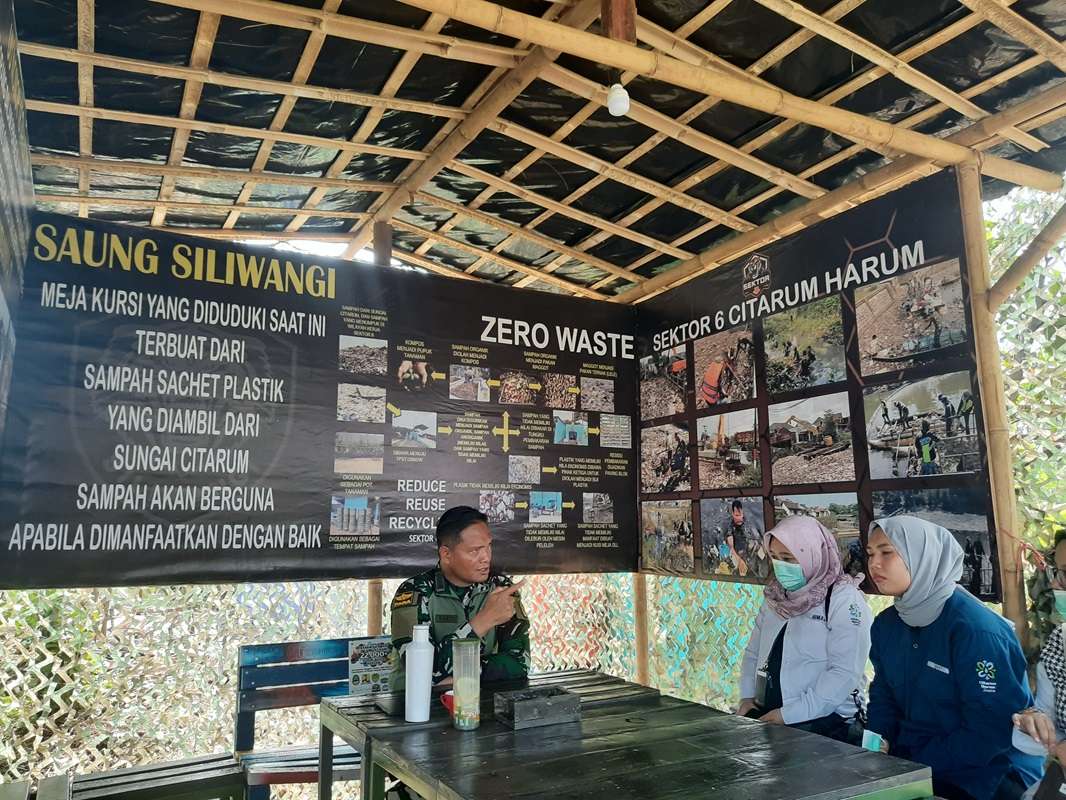
As in Sector 6 Oxbow Bojongsoang, Bandung Regency, the main problem faced is waste. This sector is led by Infantry Colonel Yanto Kusno Hendarto.
"We soldiers together with the local community work together here to process waste until there is no residue or zero waste . "We turn waste into useful products," explained Yanto in Bandung Regency, Thursday (30/5/2024).
In a day, they are able to process a maximum of 7 tons of waste taken from the Citarum River which is the responsibility of Sector 6.
So a number of products
The waste is processed into a number of products, such as paving blocks , chairs and tables, compost, and others.
In Sector 6 there are also incinerators, gibrik machines (waste sorters) and press machines for making paving blocks. There are also special heating tools for processing plastic waste.
The gibrik machine will automatically sort organic waste and plastic or inorganic waste.
The organic waste is then collected to be processed into compost or feed for maggots (a type of maggot).
Meanwhile, inorganic waste will be burned through an incinerator whose machine is located right next to the gibrik machine.
However, before it is completely burned, inorganic waste is sorted again. Plastic waste will be separated to be recycled into plastic boards as a substitute for wooden boards.
The results of burning waste from the incinerator or residue are reused. In the form of dust, it will then be mixed with sand and cement in a certain ratio. The final result is brick or paving block
"When we get new equipment, MOTAH (rubble processing machine), the capacity of processed waste can be doubled. "There will be more waste to be handled in our sector," he explained.
Sector 6 Oxbow Bojongsoang also carries out magot cultivation.
Magot is not only effective in breaking down organic waste, but also produces by-products in the form of pupae which can be used in the animal feed industry.
Class II Water Quality Target
With zero waste processing, this will support the ultimate goal as the main success indicator and target for implementing the Citarum DAS PPK action plan, namely Class II Water Quality or the equivalent of an IKA score of 60 points which is targeted to be achieved by the end of 2025.
Class II water quality allows the water to be used for water recreation infrastructure or facilities, cultivating freshwater fish, animal husbandry, irrigating crops or other uses that require the same water quality.
The initial condition of the Citarum River in 2018 was heavily polluted, equivalent to an IKA of 33.43 points. At the end of 2021, the quality improved to 50.13 points or slightly polluted.
The West Java Provincial Government and the Citarum Task Force continue to strive so that the Citarum River IKA of 9.87 points can be achieved again in the near future.
 Share News Via
 facebook
 twitter
 whatsapp
 email
email