

PORTALJABAR, BANDUNG CITY - The work of the Bandung City Fire and Rescue Department (Diskarmatan) is more than just putting out fires. Behind the wailing sirens lies a long routine, constantly honed skills, risks to face, and families awaiting their safe return.
No one truly knows what events will occur each day. Emergency reports can come in while officers are training, inspecting vehicles, resting, or performing other routine activities. Fires, animals in need of rescue, or even residents requiring evacuation can all force them to act quickly.
At the Bandung City Diskarmatan Command Headquarters (Mako), Jalan Sukabumi, readiness is built from the start of the day through inspections, training, and discipline that is continuously maintained.
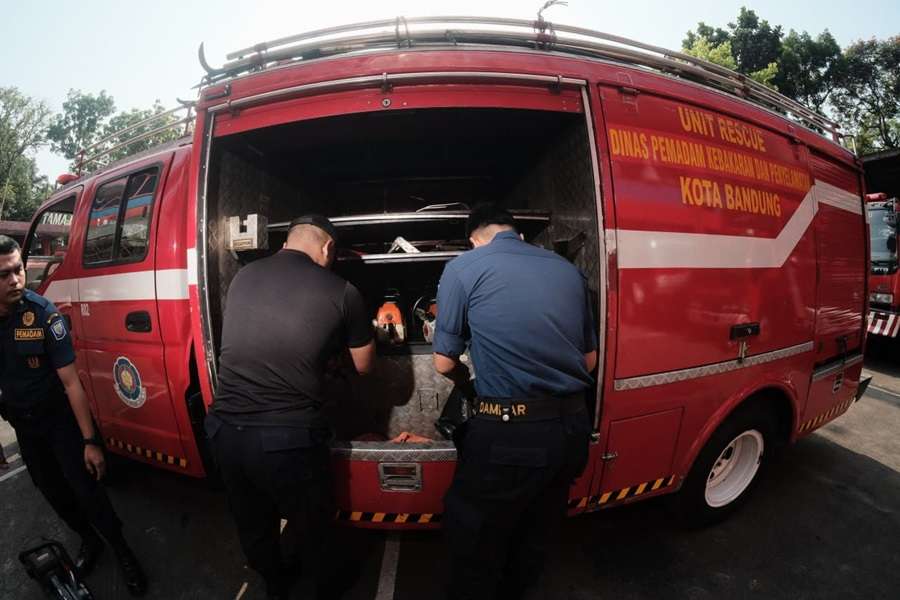
7:30 a.m. WIB marks the start of officer activity. After attending a joint roll call, personnel undergo physical training and then ensure vehicles and equipment are ready for use.
For Sendi Saputra, a rescue officer at the Bandung City Fire and Rescue Department who has been on duty since 2017, the inspection is an essential part of the job that cannot be negotiated.
Vehicles are inspected, from engine oil and brake fluid to radiator fluid. Meanwhile, rescue equipment such as chainsaws, pumps, winches, and other specialized equipment must be ensured to be in good working order.
One piece of equipment that receives special attention is the combination tool, a multi-function device used in certain situations to aid in rescue operations. Because of its critical role and the difficulty of procuring it, the condition of this equipment must be meticulously maintained.
For Sendi and his colleagues, equipment readiness is crucial to successful response at the scene. In an emergency, officers don't have much time to repair equipment that wasn't inspected initially.
Sendi's duties extend beyond firefighting. The rescue team handles a variety of non-fire related incidents, from evacuating animals that have entered homes or wells, to assisting residents struggling to remove rings, to handling accidents and other emergencies.
The skills required are diverse. Rescue workers must be prepared to navigate terrain with varying heights and depths.
Sendi, for example, holds a rescue diver certification. This skill requires mastery of diving theory, techniques, and safety procedures, which cannot be learned overnight.
Among these diverse skills, diving is one of the most challenging for him. The process requires technical knowledge and careful calculation, especially when diving to evacuate victims.
However, it wasn't just technical skills that kept Sendi in the job for nearly nine years. He began his career with no particular interest in firefighting and rescue.
"At first, I just followed my parents' wishes. When the Fire Department opened a position, my parents informed me. I didn't really like it. After a year, I started to enjoy it. In the third year, I even enjoyed it more because I was able to help people," he said when met at the Bandung City Fire Department Headquarters on Thursday (10/15/2026).
That feeling grows with experience. There's a certain satisfaction when someone in need is safely evacuated. Simple words of thanks from residents also serve as encouragement for Sendi and his colleagues.
For Sendi, the prayers and gratitude from the community are more meaningful than any material reward. He emphasized that officers do not accept money for their assistance. If residents offer money, the offer will be declined.
Behind that satisfaction, there were unforgettable experiences. One example was when the team had to rescue a child whose hand was stuck in a fence. Officers cut through the fence to free the child, who was then taken to the hospital.
Another experience comes from searching for victims of drowning. This process demonstrates that rescue efforts aren't always complete upon arrival. A series of efforts, coordination, and careful handling are required.
The risk is even greater when a fire occurs in a location that stores hazardous materials. Sendi has previously faced fires in warehouses storing ammunition and firearms. These conditions pose an additional threat because heat can trigger unpredictable hazards.
Despite this, Sendi admits that fear remains. He doesn't consider himself immune to risk. Before leaving, he prays, follows procedures, and relies on the skills he has learned.
Family is also a key part of his preparedness. Before heading to the scene, Sendi made sure to inform his family that he was on duty. After completing his assignment, he returned to inform them that he had returned safely.
Amidst the risks and uncertainties, Sendi holds on to the principles he keeps in mind.
"There are no great firefighters and rescuers, but there are trained firefighters and rescuers. So, don't get bored of practicing."
Equipment and Vehicles Must Be Ready
While Sendi ensures the readiness of rescue equipment, Maulana Iqbal is responsible for ensuring the proper operation of firefighting vehicles. As the operator of Squad 2 Platoon 2 of the Bandung City Fire Department, he inspects the vehicle engines and pumps, which are crucial to the smooth operation of the firefighting operation.
Iqbal joined as a volunteer in 2010, took part in the selection process for casual daily workers in 2015, and now has the status of a government employee with a part-time work agreement (PPPK).
According to him, fire engine maintenance is based on engine hours, not just mileage. The engine and pump can continue to operate during firefighting operations even if the vehicle is stationary.
The next challenge arises when the fleet leaves headquarters. Large vehicles must navigate narrow roads, low gates, parked vehicles, and traffic jams in several parts of Bandung.
The Police Department has set a maximum response time of 15 minutes from the time a report is received until officers arrive on the scene. Departure preparations can be completed in less than five minutes, but travel time is highly dependent on road conditions.
"If we are often said to be late, we are actually hampered," said Iqbal.
Even when time is tight, operators must prioritize safety. The use of sirens and rotating lights does not mean officers can neglect caution. Upon arrival at the scene, each team member must also carry out their duties according to their role and instructions.
Once the fire is extinguished, the task isn't completely over. Officers ensure the location is safe, check equipment, ensure personnel are fully staffed, and re-prepare vehicles for the next task.
For Iqbal, one of the happiest moments was seeing residents regain their composure after the fire was contained and ensuring there were no casualties. The waving and words of thanks from the community served as encouragement to continue working and practicing.
However, there was also sadness when the journey to the location was hampered. He imagined that if officers had arrived earlier, the fire might have been smaller and its impact could have been minimized.
After his shift, Iqbal finds renewed motivation at home. Seeing his wife and young child makes the fatigue feel different. Family motivates him to continue taking care of himself, improving his skills, and carrying out his duties responsibly.
Sendi and Iqbal's preparedness is part of a larger work system. Team arrangements, fleets, duty schedules, and procedures are established to ensure firefighting and rescue services remain operational around the clock.
Working with a 24-Hour On-Call System
The Head of the Firefighting Division of the Bandung City Fire and Rescue Service, Leonard, explained that officers are working on a 24-hour shift. The firefighting unit is supported by 207 personnel and four technical implementation units in the north, south, east, and west regions. Meanwhile, the rescue team has 43 personnel.
The Diskarmatan fleet includes 20 water trucks, three water tankers, ladder vehicles, two rescue vehicles, and other support vehicles.
According to data from the Bandung City Fire and Rescue Service, 49 fire incidents were recorded from January to September 2026. During the same period, there were 135 animal rescues and 19 human rescues.
Leonard explained that open-land fires are also a concern during the dry season. Such incidents are often found in the northern and eastern areas of Bandung City, which still have open land. Meanwhile, densely populated residential areas with narrow road access present unique challenges for firefighters.
In the field, firefighting involves more than just extinguishing the flames. Officers must also contend with difficult access, building conditions, water availability, and the situation of surrounding residents.
He emphasized that routine training is a crucial part of personnel readiness. Courage must be built through skill, discipline, and adherence to procedures.
"Firefighters are not skilled people, but trained people," said Leonard.
Behind the wailing sirens, officers are constantly training, checking equipment, and preparing for any unexpected situation. For them, success isn't just about extinguishing a fire or evacuating a victim, but also about returning all team members safely to their families. (Bandung City Communications and Information Office)
 Share News Via
 facebook
 twitter
 whatsapp
 email