

PORTALJABAR, BEKASI REGENCY - The Bekasi Regency Government is encouraging industrial areas to increase benefits for residents through local employment, regional income generation, and corporate social responsibility.
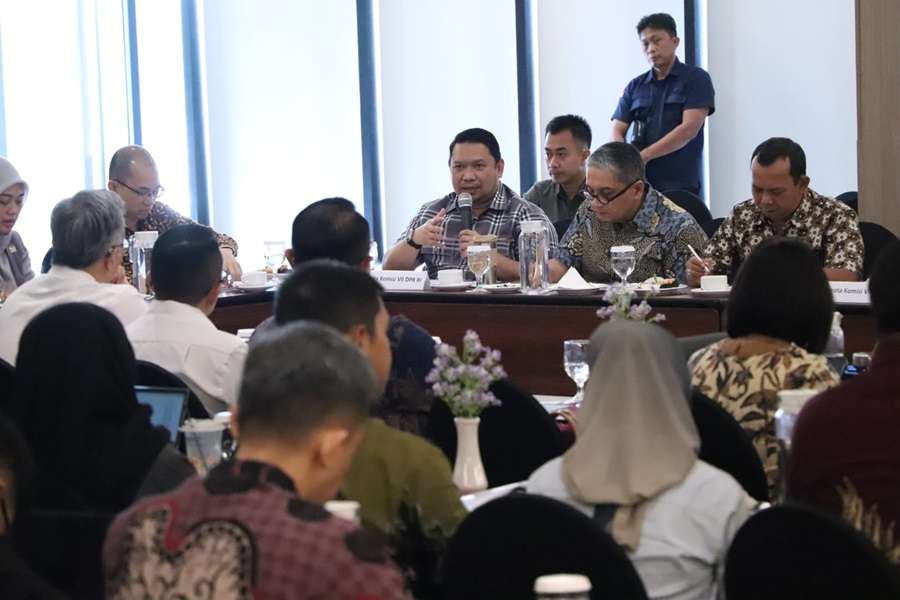
The Regional Secretary of Bekasi Regency, Endin Samsudin, conveyed this when receiving a working visit from the Working Committee (Panja) for the Draft Law (RUU) on Industrial Areas, Commission VII of the House of Representatives of the Republic of Indonesia (DPR RI).
The meeting took place at Quest Hotel Cikarang on Wednesday, September 23, 2026, to explore regional needs in industrial area regulation.
Endin said that investment in Bekasi Regency averages at least IDR 50 trillion, so it needs to be followed by economic benefits for the region.
"Given the average investment value in Bekasi Regency, which is no less than IDR 50 trillion, the state budget should also provide revenue-sharing funds for the regions. At the very least, we hope there's a calculation of how much the regions will receive from these investments," Endin said.
In addition to regional income, the Bekasi Regency Government is highlighting the absorption of local labor amid a population of around 3.4 million people.
"We hope there will be restrictions on workers from outside the region. Bekasi Regency has a population of around 3.4 million, with a productive workforce of around 50 percent, but our unemployment rate remains high," he said.
Endin also requested that industrial area regulations open up wider job opportunities for the people of Bekasi Regency.
"This is what we hope will be included in the future industrial law, particularly regarding the empowerment and absorption of local workers," he said.
The Bekasi Regency Government is also encouraging the integration of corporate social responsibility (CSR) programs with development planning to ensure that aid is more targeted.
"We want an integrated CSR program between the Bekasi Regency Government and the industrial areas within the Regency. So, through CSR planning meetings, we can map out which programs and activities should be handled by the company and which should be the responsibility of the local government," he said.
This mapping is expected to prevent overlapping programs while ensuring that the benefits of CSR are felt directly by the community.
"This will ensure there are no overlaps and the benefits can be felt directly by the people of Bekasi Regency," he said.
Chairperson of the Working Committee of Commission VII of the Indonesian House of Representatives, Evita Nursanty, said the visit aimed to explore the factual conditions of industrial areas as material for drafting the Industrial Area Bill.
"For the Working Committee, the actual conditions on the ground are crucial so that the Industrial Estate Bill will not stop at normative regulations, but will be able to address the real problems faced by both estate managers and industrial actors as tenants," said Evita.
The discussion includes land certainty, spatial planning, licensing, infrastructure, utilities, investment services, and environmental management.
The Working Committee also discussed the relationship between the central government, regional governments, area managers, and industry players in supporting business certainty.
"We want to get input on what norms really need to be regulated at the legislative level to provide business certainty, accelerate investment, while maintaining accountability, environmental sustainability, and, of course, regional interests," he said.
In addition to industrial areas, discussions also covered the national electric vehicle ecosystem, including strengthening the domestic industry and increasing the domestic component level (TKDN).
"The House of Representatives Commission VII's focus is not only on the growth of the electric vehicle market, but also on the extent to which this development can build national industrial capacity, increase local content (TKDN), strengthen the domestic supply chain, encourage technology transfer, and involve domestic industry and suppliers," Evita said.
Input from local governments, area managers, and industrial players will be used as discussion material to formulate solutions to industrial area problems.
"What we need are the challenges and problems faced by the region and industry players. These are the issues we will discuss, and the solutions to these problems will be regulated in the bill," Evita concluded.
(Bekasi Regency Communications and Information Service/bhf)
 Share News Via
 facebook
 twitter
 whatsapp
 email
email