

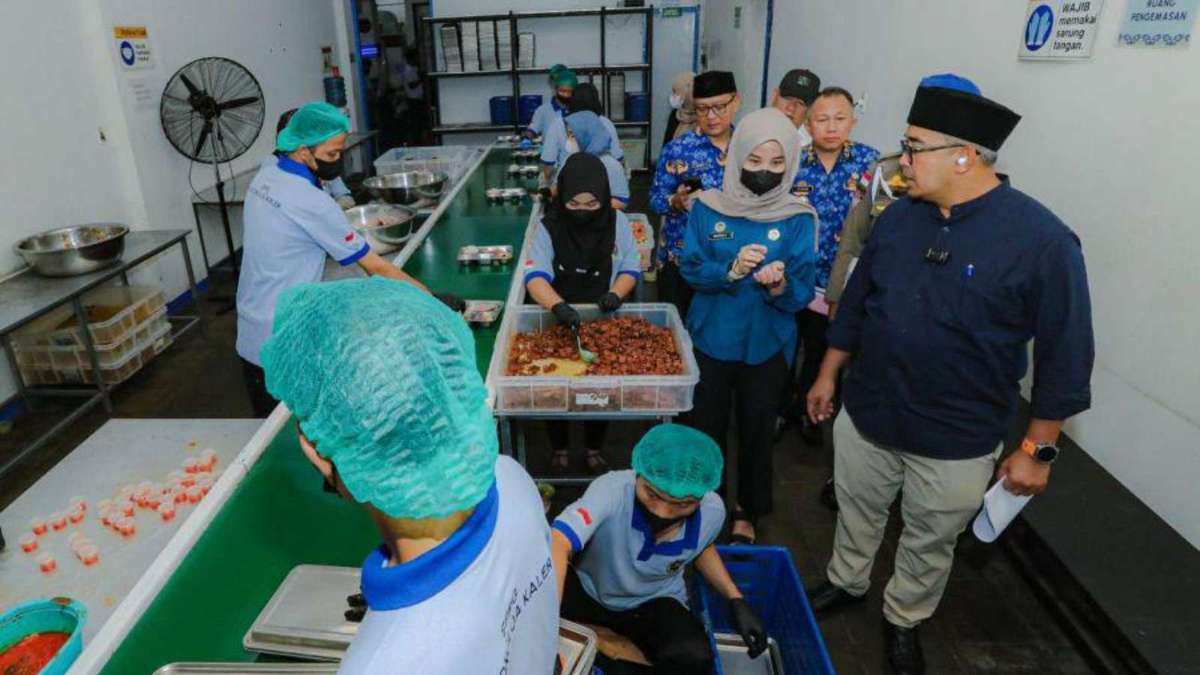
PORTALJABAR, BANDUNG CITY - Bandung Mayor Muhammad Farhan ensured that food security is a priority in the implementation of the Free Nutritious Meal Program (MBG).
Supervision of Nutrition Fulfillment Service Units (SPPG) has been tightened after health problems emerged during the implementation of MBG in various regions.
"Regarding the MBG issue, there's been a sudden explosion of poisonings all over the place. In Bandung City, we found problems in Mandalajati. Therefore, I'm really pressing every region, the Health Department, and the Food Security and Agriculture Department to ensure that the SPPG in Bandung City is running smoothly," said Farhan at Bandung City Hall on September 14, 2026.
Currently, three SPPGs are under the special supervision of the Bandung City Government, consisting of one SPPG in Mandalajati and two others in Lengkong.
This supervision ensures that SPPG improves operational aspects, especially waste management and food safety.
"We will pay close attention to this and improve it, especially in terms of waste management and food distribution. Supervision has not yet met good standards," he said.
Farhan emphasized that this step is preventive in nature by giving SPPG the opportunity to make improvements within a certain time limit.
"For me, we prevent incidents before they happen. So, if there's poor waste management, we investigate. If there's poor food safety management, we investigate. We don't just close them down. We force them to improve," he stressed.
However, the Bandung City Government will close the SPPG if repairs are not carried out and the condition has the potential to cause problems.
"If there are no improvements and it causes problems, then we will close it," he said.
The three SPPGs were given approximately two weeks to make improvements before the follow-up evaluation on September 27, 2026.
During the evaluation period, SPPGs are still allowed to operate with strict government supervision to ensure food safety.
"I will conduct another evaluation on September 27th. During that time, we can still produce MBG, but we will continue to monitor it," said Farhan.
This supervision is carried out to prevent health problems caused by MBG food which have occurred in a number of areas from occurring.
Farhan ensured that the Bandung City Government fully supports MBG as a national strategic program through its supervisory and control functions.
"I emphasize that the Bandung City Government fully supports the Free Nutritious Meals program, not by being involved in the operation of the SPPG," he said.
Farhan revealed that before being inaugurated in February 2025, the Bandung City Government received an offer to build and operate a regional government-owned SPPG.
In fact, there was an offer for Farhan to personally participate in building the SPPG, but the offer was rejected due to considerations of the local government's capacity.
According to Farhan, local governments need to understand their capacity and not take on roles beyond their management capabilities.
He explained that there are three schemes for implementing the program, namely the central government with the TNI and Polri, regional governments, and the private sector.
The first scheme is a collaboration between the central government through the National Nutrition Agency with the TNI and Polri which is already underway.
For the second scheme, Farhan chose not to be directly involved in the operation of the SPPG which is managed through cooperation with the central government.
"We allow the central government's scheme for the private sector, but I forbid myself from owning and operating an SPPG," he said.
Currently, the number of SPPGs in Bandung City is approaching 300 units and all of them are required to meet the requirements and have certification before operating.
"It must be certified. If it's not certified, we can't operate," he stressed.
Supervision of nearly 300 SPPGs is carried out across regional agencies to ensure food quality and safety for beneficiaries.
The Health Service and the Food Security and Agriculture Service (DKPP) are the main parties in ensuring food quality and safety.
In addition, the Environmental Service (DLH), the Education Service, and regional elements also supervise the implementation of MBG in accordance with the provisions.
Farhan asked all sub-district heads and village heads to record SPPGs in their respective areas and also to monitor their operations.
"All village heads and sub-district heads are required to record and supervise all SPPGs in their area," he said.
Specifically for Lengkong and Mandalajati Districts, Farhan requested more intensive supervision because there are SPPGs under special supervision.
The Bandung City Government is also paying attention to the waste problem from SPPG activities, which reaches around 50 tons per day.
"The Environmental Agency (DLH) has identified 50 tons of waste per day from SPPG," he said.
Most of this waste is organic waste, so its management needs to be strengthened to support the success of urban waste management.
"Therefore, we are currently strengthening waste management, because organic waste management is the key to our success in managing waste as a whole," he explained.
The Department of Trade and Industry also ensures that the availability of SPPG food ingredients does not disrupt the supply of community needs in the market.
With cross-regional oversight, Farhan hopes that the implementation of the MBG will run optimally while still prioritizing food safety.
According to him, the success of MBG is not only determined by the quantity of food distributed, but also the quality of food to the beneficiaries.
"However, one of the keys to success is delivering good quality food to students," he concluded.
(Bandung City Communications and Information Service/bhf)
 Share News Via
 facebook
 twitter
 whatsapp
 email