

PORTALJABAR, BEKASI REGENCY - The Bekasi Regency Government has temporarily halted the development of housing developments that are still experiencing flooding, including those that have permits, to protect thousands of residents from the risk of high inundation (26/1/2026).
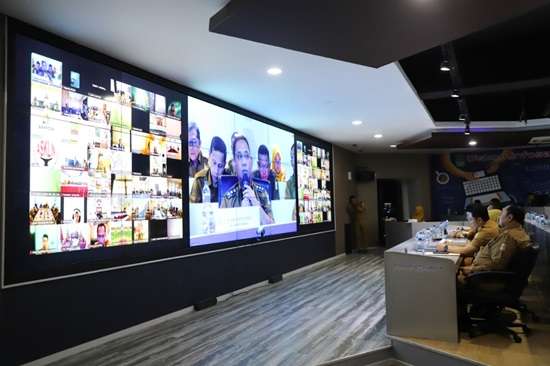
The decision was announced by Acting Regent of Bekasi Asep Surya Atmaja after the Public Consultation Forum for the 2027 Regional Government Work Plan.
"Even those with permits, if the housing is still flooded, no development is allowed. Fix the flooding first, then the permits can be reissued. Especially those without permits," Asep said.
This policy emerged as a response to the increasing number of residential areas that are prone to flooding and do not yet have adequate spatial planning.
Asep stated that around 85 percent of residential areas were affected, with 51 villages and 216 locations recorded as experiencing flooding due to rising water levels in the Citarum River and CBL Canal.
According to him, the flood pattern indicates errors in the initial planning, so a comprehensive identification is now being carried out to map the causes, ranging from land conversion, poor drainage, to river conditions.
Asep emphasized that developers would be summoned to confirm their commitment to resolving flooding in their respective areas before obtaining further permits.
"Today I called several developers. I told them to resolve the flooding first. No more housing developments are allowed until the flooding is resolved," said Asep.
He added that housing that has not yet handed over infrastructure, facilities and utilities to the local government remains the responsibility of the developer, including repairing damaged infrastructure.
"If it's a housing development and hasn't been handed over to the local government, that's the developer's responsibility. The government can't be held responsible for construction that's been faulty from the start," he explained.
Deputy Chairman of the Bekasi Regency DPRD, Budi Muhammad Mustofa, fully supports the steps taken to regulate developers, especially those who have not resolved the flooding and have not handed over social and public facilities.
Budi said that all DPRD members actively went into the field to ensure that residents' voices were heard, especially regarding losses due to residential flooding.
"Almost all DPRD members went directly to the field. One thing that must be proposed going forward is sustainable infrastructure development, so that repairs in one area don't shift flooding to another," said Budi.
He found that a number of old housing complexes had not yet handed over facilities to the local government, and some developers were no longer operating.
"We've instructed neighborhood associations (RT) and community associations (RW) to write a letter to the Regent, who then has it checked with the Department of Housing and Settlements. Housing units with neglected social and public facilities must be recorded so that their development can be followed up," he said.
Budi believes that regulating developers is part of equitable development so that no village is left behind.
Regarding subsequent oversight, he opened up the opportunity for cross-commission collaboration to summon developers and ensure compliance with spatial planning regulations.
"We will discuss this internally within the Regional People's Representative Council (DPRD). In principle, developers must be responsible, and development must support the interests of the community," Budi concluded. (Bekasi Regency Communications and Information Office/Fau)
 Share News Via
 facebook
 twitter
 whatsapp
 email
email