

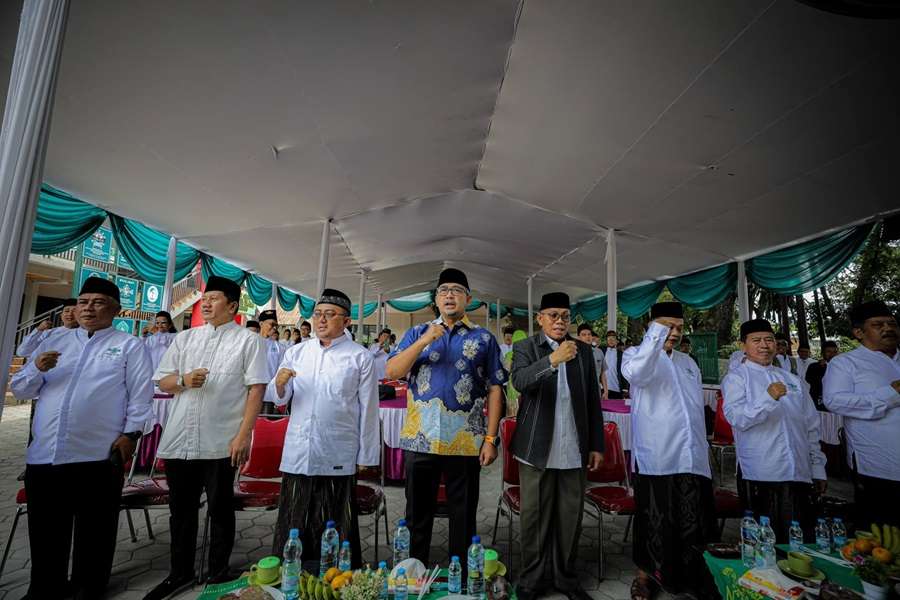
PORTALJABAR, BANDUNG CITY - The Bandung City Government is encouraging the involvement of Nahdlatul Ulama (NU) down to the neighborhood association (RW) level to help resolve community problems through regional-based empowerment.
Bandung Mayor Muhammad Farhan conveyed this when opening the Second Branch Working Conference (Muskercab) of the Nahdlatul Ulama Branch Management (PCNU) of Bandung City at the PCNU Office Hall in Bandung City, Sunday (25/10/2026).
Farhan believes that the NU network, which includes Islamic boarding schools, religious study groups, and mosques, can expand community participation in resolving social issues in their respective communities.
According to him, partnership between the government and religious scholars is necessary so that public policies take into account the values, aspirations, and needs of the community from the very beginning of the formulation process.
"This collaboration or partnership is highly strategic. The government's actions must be validated by religious scholars," said Farhan.
He emphasized that early communication can help the government identify potential problems and find joint solutions before policies are implemented.
"If it's deemed potentially violating a principle or perhaps a specific law, then a warning should be given from the start. And what I like is that it's not just a warning, but that we work together to find a solution," he said.
NU Encouraged to Empower Citizens
Farhan hopes that NU will play an active role in community empowerment by optimizing the religious and community networks that have grown among the residents.
"NU must be able to become, in quotation marks, an agent of government empowerment," he said.
The Bandung City Government also encourages problem solving through a regional approach by involving sub-district heads, village heads, RW administrators, and the community.
One of the efforts is carried out through the Disaster Alert Siskamling program, which provides a space for Farhan to discuss directly with the village head and RW head regarding residents' problems and needs.
Farhan believes that the involvement of regional officials and the community can accelerate problem identification and encourage solutions that are appropriate to the conditions of each environment.
"My hard work as mayor is getting easier and easier. Now, my leadership spirit has spread to the sub-district heads and village heads," he said.
He hopes that collaboration with NU will expand community participation in protecting the environment, developing social awareness, and solving problems together.
"With the Nahdlatul Ulama network, the kiai can reach mosques at the neighborhood level. If one neighborhood has more than two mosques, this will help foster a spirit of working together to solve local problems," he said.
Through this partnership, the Bandung City Government hopes that the NU network can help reach the needs of residents at the neighborhood level and encourage more targeted community empowerment.
(Bandung City Communications and Information Service/bhf)
 Share News Via
 facebook
 twitter
 whatsapp
 email