

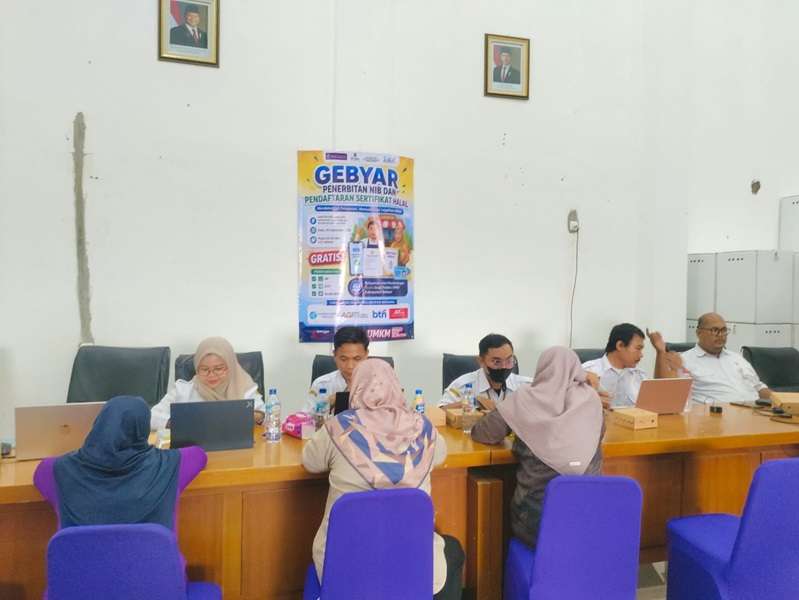
PORTALJABAR, BEKASI REGENCY - The Bekasi Regency Government (Pemkab) continues to expand services to micro-entrepreneurs through outreach programs for Business Identification Numbers (NIB) and halal certification.
One of the services took place at the Waluya Village Hall, North Cikarang District, Bekasi Regency, on Wednesday (30/9/2026).
This activity involved the Bekasi Regency Investment and One-Stop Integrated Services Agency (DPMPTSP) together with the Cooperatives and MSMEs Agency and the Halal Product Guarantee Agency (BPJPH).
Head of the Micro Business Empowerment Division of the Bekasi Regency Cooperatives and MSMEs Office, Agus Dwi Riyanto, said the collaboration is expected to expand public access to various business legalities.
According to Agus, many MSMEs are still unaware of the importance of NIB, halal certificates, PIRT, business permits, and HAKI.
"We hope this service will benefit many people. When we go into the field, many people still don't understand the importance of NIB, halal certification, PIRT, and other permits, including intellectual property rights," he said.
He added that the Bekasi Regency Government will continue to promote services down to the village, sub-district, and district levels so that people do not have to travel all the way to government offices to receive assistance.
"We are pushing all services down to the lowest level so that our community can be served," he concluded.
First, Regular Halal Certification.
This scheme is carried out through a process of inspection and/or testing of product halalness by the Halal Inspection Agency (LPH) by involving halal auditors.
The inspection results then serve as the basis for determining halal status before BPJPH issues a Halal Certificate. This scheme can be used by micro, small, medium, and large businesses, subject to applicable regulations.
Second, Halal Certification through Self-Declaration or Halal Statement. This scheme provides convenience, especially for Micro and Small Enterprises (MSEs) that meet the requirements.
In the process, business actors make a product halal statement and it is verified and validated by the Halal Product Process Companion (P3H).
The process then proceeds through the SIHALAL system until BPJPH issues a halal certificate. This way, MSMEs don't have to worry about choosing the right path. If they meet the Self-Declaration requirements, they can take advantage of the scheme. If they don't meet the criteria, certification is carried out through the Regular scheme.
Halal certification is not only about fulfilling regulatory obligations but also adds value to MSME products, boosting consumer trust, expanding market access, and enhancing business competitiveness. The Cooperatives and SMEs Office (Dinkop UMKM) also facilitates halal licensing for MSMEs.
"Quality products, complete legality, and halal certification will increase consumer confidence. It's time for MSMEs to move up a level with halal, safe, and reliable products," he said.
Head of the Socio-Economic Licensing Team of the Bekasi Regency DPMPTSP, Sarwoko, said the activity was part of the Gebyar NIB program, by providing direct assistance to the community in the process of issuing NIBs as well as halal certification services.
"So, this is our NIB Celebration. Here, we provide support services from NIB issuance to halal certification registration. We're proactively working to make it easier for people to obtain NIBs," he said.
He explained that the NIB provides legality for business actors. According to him, every business actor, including very small-scale businesses, needs a NIB to identify and legalize their business.
"The NIB stands for Business Identification Number. It's the legality for business owners. No matter how small their income, business owners are required to have a NIB," he explained.
Sarwoko explained that the NIB also replaces a number of licensing documents previously known to the public, such as the Trade Business License (SIUP), Company Registration Certificate (TDP), and Business Domicile Certificate (SKDU).
Besides providing legality, NIB is also needed by MSMEs to develop their businesses, including when accessing financing such as People's Business Credit (KUR) through banks.
"The NIB also serves as a requirement for MSMEs to expand their businesses. This requires capital investment, one way being through KUR (People's Business Credit) loans (KUR) from banks, and that certainly requires a NIB," he said.
Sarwoko added that the NIB can also be used for a number of other services. He stated that businesses can register their NIB with PLN to receive electricity discounts, provided the NIB and customer ID data match.
In addition, NIB data is also one of the government's sources for recording business actors who have the potential to receive assistance programs.
"When the government wants to provide assistance, it always takes its data from the NIB. So, if individuals or businesses don't have a NIB, they will have difficulty being registered for government assistance programs," he said.
According to Sarwoko, the outreach service is being implemented because there are still people who need assistance in using digital-based licensing services.
The NIB itself can be created online and independently. However, the Bekasi Regency Government is directly present among the community to assist business owners who are unsure about the registration process.
"This NIB is indeed online and self-service. People can actually apply for an NIB anytime and anywhere. But we make it easier by taking the initiative and assisting them in obtaining their NIB," he said.
To meet the requirements, residents simply need to bring their ID card, phone number or WhatsApp number, and a mobile phone number to receive an OTP code. The NIB issuance process is relatively quick and free of charge.
"The only requirements are an ID card, a phone number or WhatsApp number, and a mobile phone number to receive an OTP. It's that simple. The NIB is free, no fees are charged, and can be issued immediately," Sarwoko emphasized.
This outreach program is carried out routinely every week, moving from one area to another. Previously, the Bekasi Regency DPMPTSP also targeted markets within Bekasi Regency.
"We routinely go around the village once a week, conducting roadshows. Previously, we conducted roadshows at markets in Bekasi Regency. We visited 12 markets," he said.
Now, the service target has been expanded to villages. Sarwoko stated that approximately 170 villages in Bekasi Regency are targeted by the service roadshow.
"Now we're moving to the villages. We conduct roadshows once a week at village offices. Essentially, we're bringing services closer to the community so they feel comfortable with the government," he said.
He emphasized that this activity represents a concrete example of the Bekasi Regency Government's commitment to providing accessible and accessible services to the community. (Bekasi Regency Communications and Information Service/rka)
 Share News Via
 facebook
 twitter
 whatsapp
 email
email