

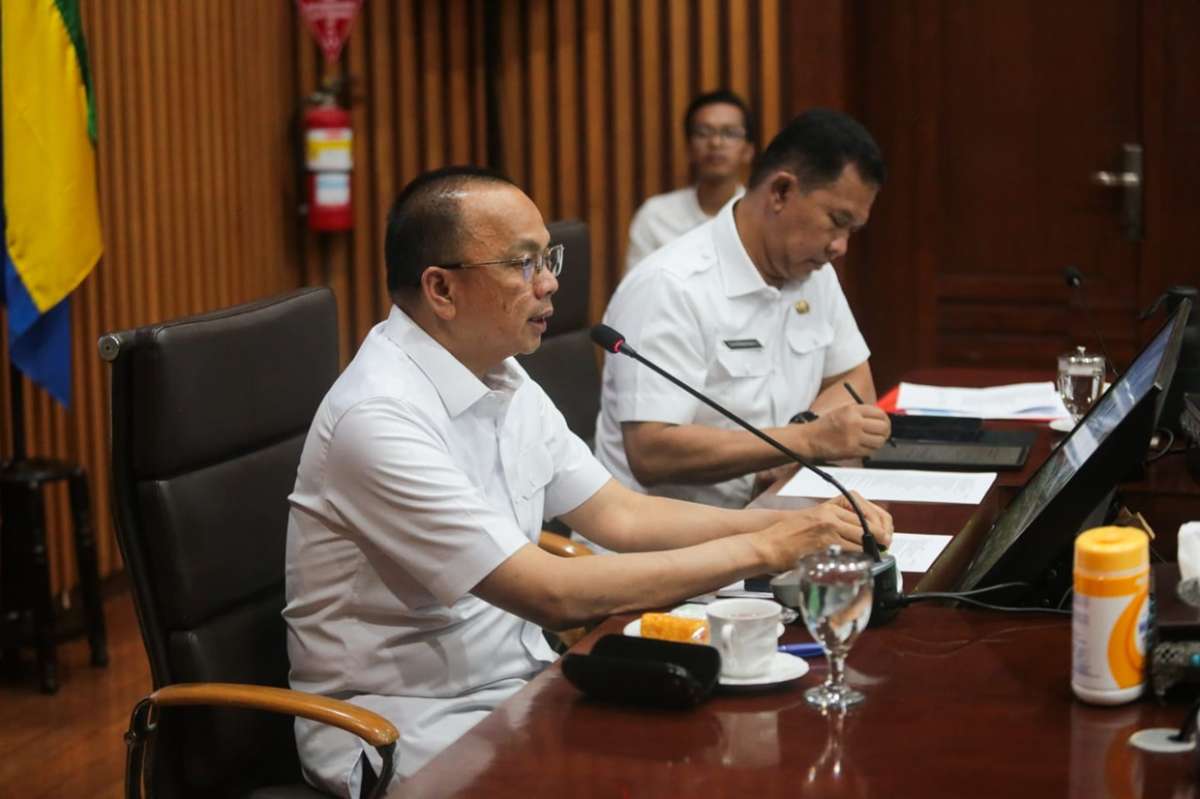
PORTALJABAR, BANDUNG CITY - The Bandung City Government continues to intensify waste management at all levels. Starting from education elements, restaurant entrepreneurs, Islamic boarding schools, to being encouraged to sort their waste independently.
This time, Acting Mayor of Bandung, A. Koswara invited Regional-Owned Enterprises (BUMD) to manage waste starting from its source. Koswara is confident that BUMD can embrace the community to manage waste.
"It requires a comprehensive strategy to deal with the waste problem. Several things have been communicated with several associations including PHRI, AKAR, universities to world world centers," said Koswara at the Silaturahmi activity with BUMD, at the Bandung City Hall (6/11/2024).
He said that the cultural movement to sort waste is important as the beginning of waste management.
"Because of the cultural movement, the involvement of all parties is very important. We invite concern to build a culture of comprehensive waste resolution. This must be a mass movement to manage waste independently from its source," said Koswara.
According to him, the culture of throwing away garbage without sorting it must be changed by sorting it at home, at the office or at each place.
"The key from the source is in sorting. The culture of throwing away waste without sorting must be changed. The government has prepared a processing method. By sorting, 50 percent of the processing process has been done, the next process will be very easy and efficient," he explained.
He said that Social and Environmental Responsibility (TJSL) is carried out together with BUMD or BUMN in the form of waste management.
"Assisted by the role of entrepreneurs, BUMN and BUMD in the form of joint programs for waste management, later it can be processed at the source in RT and RW in the form of sorting tanks," he said.
Although the Sarimukti TPA is still limited, Koswara said that the City of Bandung has taken a stance not to depend on the TPA.
"Sarimukti TPA can probably be used optimally again in late 2025 or 2026. We take a stance not to depend on TPA, so strengthen management from the source and end up at TPS. Even if it goes to TPA, the residue is really a maximum of 30 percent. Estimated 500-600 tons of waste production," he explained.
"The rest is processed and reused and produces a circular economy for the community. This is what is expected. The strategy must be used consistently. Good waste sorting must be cultivated," added Koswara.
He said, from 383 RW already have a circular economy processing waste and producing products. For example maggots, compost, agricultural products, Buruan Sae.
"The number of TPS is 135, only 8 are TPS 3R. There is a role for entrepreneurs, for example, to foster TPS, formed into TPS 3R. Hopefully it can be a motivation for concern for the City of Bandung," he said. (Bandung City Communication and Information Service/Fauziah)
 Share News Via
 facebook
 twitter
 whatsapp
 email
email