

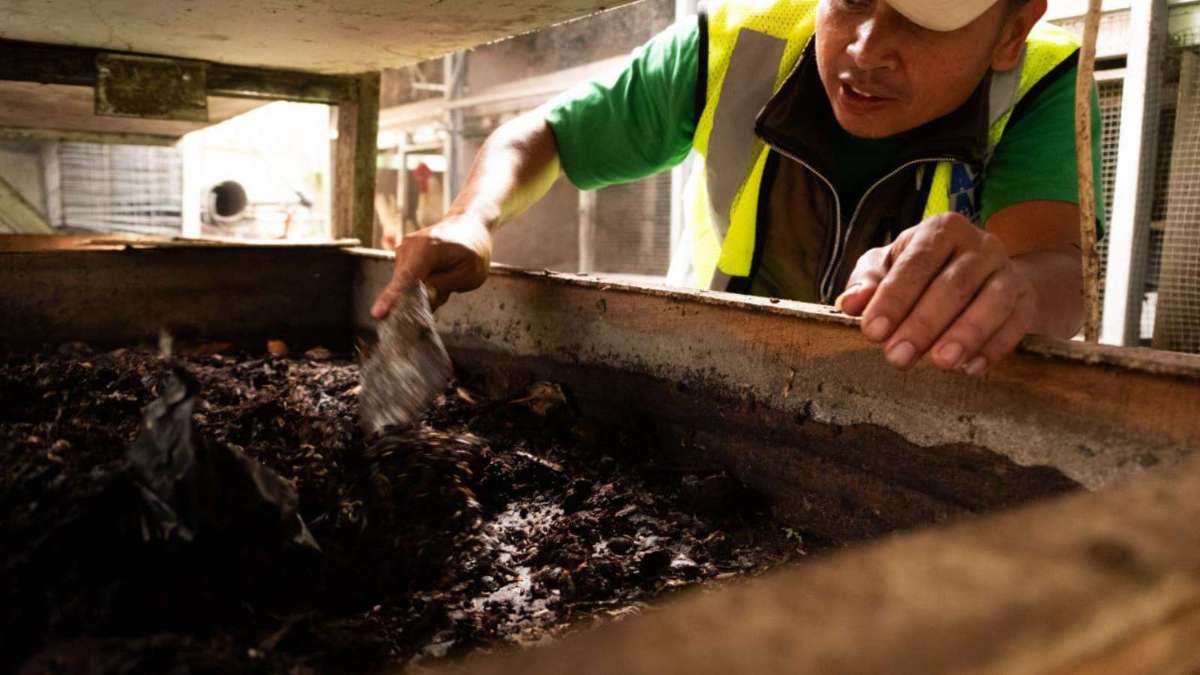
PORTALJABAR, BANDUNG CITY - The Bandung City Government strengthened community-based organic waste management in Pasirlayung Village through collaboration between residents, maggot houses, chicken farms, and integrated waste banks on June 23, 2026.
This program is part of the city's waste management efforts with a regional-based processing system so that all waste is no longer taken to Temporary Shelters.
Head of the Economic and Development Section of Pasirlayung Village, Nani Mulyani, said that organic waste management can now be completed directly at the village level.
"Thank God, in Pasirlayung Subdistrict, we have made every effort to manage waste as well as possible. We have been able to manage organic waste in the area so it is no longer disposed of at the landfill," he said.
Currently, there are a number of organic waste processing points spread across several RWs with an integrated maggot house and chicken farming system.
The processing locations are in RW 02, the sub-district office, RW 12, RW 08, RW 06 in the Saung Angklung Udjo area, and RW 13 Bumi Asri Housing.
Every day, residents' organic waste is sent to this location to be processed into maggot feed and chicken feed.
"Every day, waste collectors take organic waste to the maggot house and chicken coop. Therefore, organic waste is no longer sent to the landfill," he explained.
In addition to organic waste, inorganic waste management is also strengthened through 13 Unit Waste Banks throughout the sub-district area.
Waste with economic value is sorted, weighed, and distributed to the Main Waste Bank through collaboration with the Bandung City Environmental Service.
The system not only reduces the volume of waste but also provides economic value to the local community.
"We involve the community, gas station officers, waste collectors, and all environmental managers. Waste management must be a shared responsibility because the waste originates from our own bodies," he said.
In several RWs, additional processing facilities such as ground tanks, incinerators, and compost and liquid fertilizer processing have also been developed.
The results of this processing are reused by residents for agricultural and household needs.
"Every week, residents come to collect compost and liquid fertilizer from the waste processing to be reused," he said.
Pasirlayung Subdistrict Waste Free Area Facilitator Herlan Soemantri explained that the success of this program began with changes in people's behavior in sorting waste at home.
"Trash must be sorted from home. Once sorted, it is then transported by Gaslah officers daily. Unsorted organic waste will be sorted again by officers before being sent to the processing facility," he said.
Organic waste is then separated into three categories, namely animal feed, maggot feed, and compost through a composter drum.
"With this system, all organic waste can be utilized. Nothing goes to waste," he said.
Based on field data, organic waste production in Pasirlayung Subdistrict reaches around 560 kilograms per day or around 12 tons per month.
Meanwhile, the processing capacity of the maggot houses in RW 02 and RW 03 currently ranges from 50 to 75 kilograms per day.
The target for future processing capacity development is planned to increase to 300 kilograms per day to expand waste processing services in the region.
"The future target, according to Mr. Linus' plan, is to increase processing capacity to around 300 kilograms per day so that more of the residents' waste can be handled directly in the area," he explained.
Herlan emphasized that collaboration between all elements of society is the key to the success of regional-based waste management.
"Collaboration is key. The government, community, and universities must work together to build a sustainable waste management system," he said.
The integrated system in Pasirlayung also connects chicken coops with maggot farming so that waste is no longer an environmental problem.
Chicken manure is used as a medium for cultivating maggots, while organic waste from residents is the main source of feed.
"The innovation is that all elements are interconnected. Chicken manure is not a problem because it is utilized by maggots. Residents' organic waste is also immediately processed. This system is very suitable for residential areas because it doesn't produce odors," explained Herlan.
All incoming organic waste is guaranteed to be processed completely without leaving any residue to be disposed of at the TPS.
"It's all gone. There's no organic waste left to throw away," he said.
Nani Mulyani hopes this management model can serve as an example for other areas in Bandung City in building a culture of waste management from its source.
"Our hope is that we can work together to manage waste properly. Waste comes from us, so we are responsible for managing it. If the entire community works together, we can solve the waste problem in Bandung City, starting from our respective communities," he concluded.
(Bandung City Communications and Information Service/bhf)
 Share News Via
 facebook
 twitter
 whatsapp
 email
email