

PORTALJABAR, BANDUNG CITY - The Bandung City Government is tightening regulations on street vendors (PKL) so that trading activities do not disrupt public spaces.
Bandung Mayor Muhammad Farhan said street vendors are still allowed to trade as long as they follow the rules and maintain the function of public facilities.
This was conveyed by Farhan during the 101st Disaster Alert Community Watch (Siskamling) in Cibaduyut Village, Bojongloa Kidul District, September 8, 2026.
Farhan emphasized that no permanent or semi-permanent facilities or buildings should be built in public spaces.
"For me, the most important benchmark right now is that street vendors don't build permanent or semi-permanent facilities or structures. That's the most important thing," said Farhan.
The Bandung City Government is also encouraging the regulation of street vendors' operating hours to ensure orderly trading activities and a clean environment.
"At that point, there's only one operating hour allowed. That's fine, but you have to come in clean and leave clean," he said.
This pattern has been implemented in a number of areas, including Jalan Lengkong Kecil, Jalan Cikuray, Taman Journalist, Panjunan, and Kiaracondong Market.
In Lengkong Kecil, for example, street vendors can sell from 6:00 PM to 11:00 PM WIB according to local regulations.
Farhan emphasized that traders can still earn a living as long as they comply with the arrangement and do not use public spaces as residences.
"I can't possibly ban street vendors from selling. But these street vendors must regulate themselves and comply with regulations. If they don't comply, they'll be forced to be disciplined," he said.
Farhan also asked sub-district heads, village heads, and heads of neighborhood associations (RW) not to collect illegal levies from street vendors on the grounds of rent or security.
"If I get caught, I'll make a sledgehammer right away. That's it, I'll take care of it," said Farhan.
Apart from street vendors, the Bandung City Government prohibits permanent or semi-permanent buildings from being built on sidewalks and water channels.
"It can't be permanent or semi-permanent on sidewalks, let alone on water channels. There's no compromise," he said.
Farhan asked for buildings that obstruct the flow of water to be dismantled, including security posts and other facilities standing in the canal.
According to Farhan, this regulation applies to all parties without differentiating between the functions or institutions that use the building.
"In fact, it's even more wrong for places of worship to violate regulations. Right? If it's wrong, it's wrong. It doesn't mean that the rules are different just because of who uses it," he explained.
The enforcement also targets street vendors selling alcoholic beverages and illegal drugs to maintain public safety.
"If we're caught selling alcohol or Tramadol, we'll crack down. It doesn't take much time, it doesn't take much time," he said.
Farhan acknowledged that limited personnel and equipment meant that enforcement required support from the TNI-Polri, sub-districts, urban villages, and the community.
According to him, the arrangement of a number of areas proves that street vendors and the government can work together when both parties are committed to implementing the regulations.
“The key is commitment,” he said.
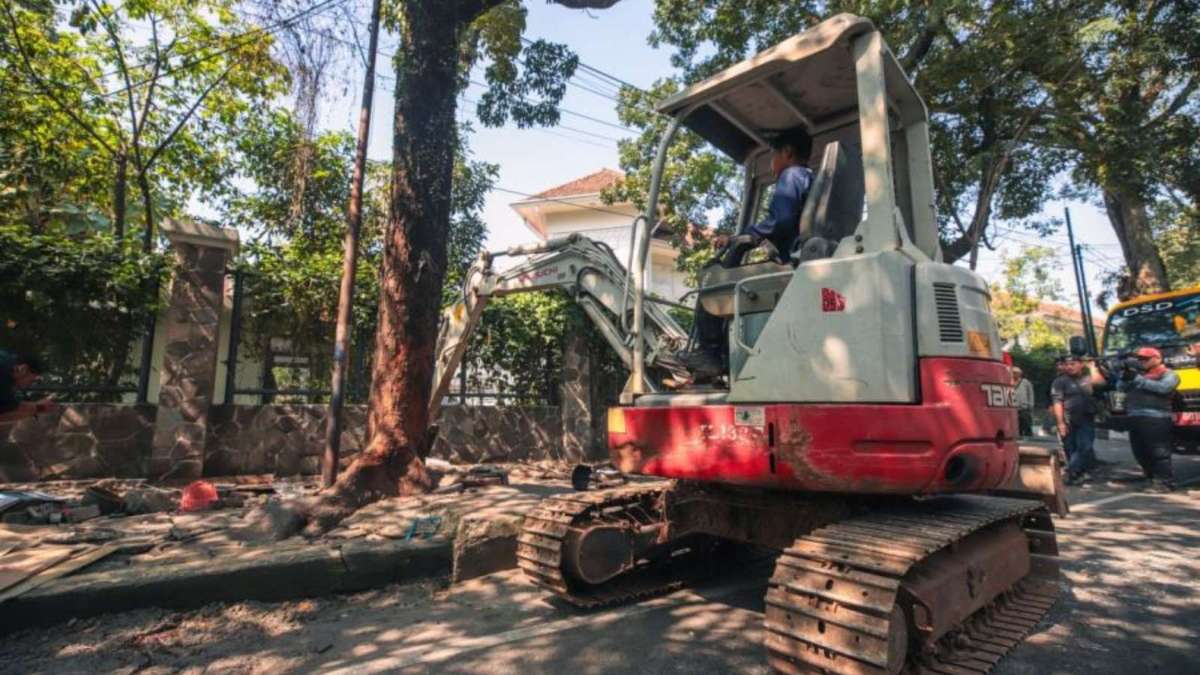
The Bandung City Government is also repairing sidewalks on a number of roads to restore the function of pedestrian spaces for the public.
Farhan asked the public and regional officials to suggest sidewalk areas that require repair so that they can be handled more appropriately.
Sidewalk repairs have been carried out in the Otista and Cicadas areas which are integrated with the development of the Bus Rapid Transit (BRT) system.
This arrangement is expected to restore pedestrian space to its normal function and create a more orderly urban area.
In the Cibaduyut area and around Jalan Soekarno-Hatta, the Bandung City Government is also addressing a number of flooding points due to issues with drainage capacity and conditions.
The narrowing of the canal when entering the Bandung Regency area has the potential to impede water flow during heavy rain.
The Bandung City Government is considering channel normalization as a short-term measure to reduce flooding and speed up water receding.
Farhan asked residents in border areas to work together to address environmental and flood issues so that they can be handled more quickly.
"I'm asking for action to begin this September to reduce the risk. This is a citizen-to-citizen relationship, not a department-to-department relationship," he said.
The government continues to provide support through sub-districts, urban villages, and regional apparatus to accelerate the handling of environmental issues.
"It's better if it's implemented by residents alone, but supported by the strength of the service," he said.
(Bandung City Communications and Information Service/bhf)
 Share News Via
 facebook
 twitter
 whatsapp
 email
email